>
Gobiiformes (Gobies) >
Gobiidae (Gobies) > Gobiinae
Eponymy: Dr Frederik Petrus Koumans (1905–1977) was a Dutch ichthyologist who was Curator of Fishes at Rijksmuseum van Natuurlijke Historie (Leiden, Netherlands). [...] Edward Henry Rainford (1853–1938) was an English-born Australian amateur naturalist who was viticulturist at the Queensland Agricultural Department, based at Bowen in north Queensland. He collected specimens of fauna and flora for the Australian Museum. (Ref. 128868), visit book page.
More on author: Whitley.
Ambiente: milieu / zona climatica / distribuzione batimetrica / gamma di distribuzione
Ecologia
marino associati a barriera corallina; distribuzione batimetrica 2 - 30 m (Ref. 27115), usually 3 - 30 m (Ref. 27115). Tropical; 22°C - 30°C (Ref. 27115); 19°N - 24°S
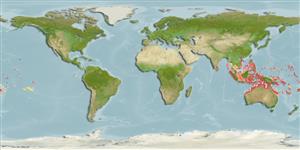
Western Pacific: from the western and eastern Australia to Tonga; north to Taiwan and the Philippines; throughout Indonesia, Papua New Guinea, Marshall Is., Solomons, and Fiji.
Dimensione / Peso / Età
Maturità: Lm ? range ? - ? cm
Max length : 8.5 cm SL maschio/sesso non determinato; (Ref. 48637)
Breve descrizione
Chiavi di identificazione | Morfologia | Morfometria
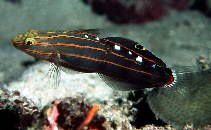
Spine dorsali (totale) : 7; Raggi dorsali molli (totale) : 15 - 17; Spine anali: 1; Raggi anali molli: 15 - 17. This species is distinguished by the following characters: D VI + I,15-17 (first 2 dorsal-fin spines filiform, elongate, remaining progressively shorter); A I,15-17; pectoral-fin rays 16-18; united pelvic fins, frenum absent; rounded caudal fin; scale in series, longitudinal 55-61 and transverse 17-19; interorbital wide, 75-100 % of eye diameter; rear margin of upper jaw ending at vertical through anterior margin of eye or slightly behind; scales ctenoid posteriorly, becoming cycloid anteriorly between first dorsal fin and pectoral fin, at axil of pectoral fin, on nape and entire belly; predorsal scales 24-26; scales do not reach level of the posterior edge of the eye on predorsal area, ending at the level of pore G; naked cheek and opercle, in some specimens with a few cycloid scales in upper part; scales cover the basal 1/4-1/6 of the caudal fin, becoming rapidly smaller and cycloid; prepectoral area with about 5-9 vertical series of fine cycloid scales which cover the entire base of the pectoral fin; prepelvic area with cycloid scales, 11-16 in the midventral row (Ref. 119548). Colour of body charcoal grey with 5 dark-edged orange to reddish stripes; upper back with a row of white spots; yellow-edged black spot on second dorsal fin; upper caudal fin base with black spot (Ref. 90102).
Body shape (shape guide): elongated; Cross section: compressed.
Inhabits sandy and muddy bottoms of turbid coastal reefs (Ref. 1602) to depths pf 20m (Ref. 48637). Solitary or in small groups (Ref. 90102). Does not appear to use a burrow and seen in areas with coral growth (Ref. 1602).
Ciclo vitale e comportamento di accoppiamento
Maturità | Riproduzione | Deposizione | Uova | Fecondità | Larve
Kovačić, M., S.V. Bogorodsky, A.O. Mal and T.J. Alpermann, 2018. Redescription of the genus Koumansetta (Teleostei: Gobiidae), with description of a new species from the Red Sea. Zootaxa 4459(3):453-481. (Ref. 119548)
Stato della Lista Rossa IUCN (Ref. 130435: Version 2025-2 (Global))
Minaccia per l'uomo
Harmless
Usi umani
Pesca: di nessun interesse; Acquario: Commerciale
Strumenti
Rapporti speciali
Scarica XML
Fonti Internet
Stime basate su modelli
Temperatura preferita (Fonte Biblio.
123201): 25.7 - 28.9, mean 27.8 °C (based on 574 cells).
Indice di diversità filogenetica (Fonte Biblio.
82804): PD
50 = 0.6250 [Uniqueness, from 0.5 = low to 2.0 = high].
Bayesian length-weight: a=0.00741 (0.00347 - 0.01582), b=3.09 (2.91 - 3.27), in cm total length, based on LWR estimates for this (Sub)family-body shape (Ref.
93245).
Livello trofico (Fonte Biblio.
69278): 3.3 ±0.4 se; based on size and trophs of closest relatives
Resilienza (Fonte Biblio.
120179): Alto, tempo minimo di raddoppiamento della popolazione meno di 15 mesi (Preliminary K or Fecundity.).
Vulnerabilità della pesca (Ref.
59153): Low vulnerability (10 of 100).
🛈
Nutrienti (Ref.
124155): Calcium = 162 [70, 329] mg/100g; Iron = 0.871 [0.406, 1.764] mg/100g; Protein = 17.4 [15.4, 19.2] %; Omega3 = 0.083 [0.035, 0.168] g/100g; Selenium = 26.1 [11.6, 64.3] μg/100g; VitaminA = 113 [23, 528] μg/100g; Zinc = 2.69 [1.66, 4.15] mg/100g (wet weight);