Klassifizierung / Names
Namen | Synonyme | Catalog of Fishes(Gattung, Arten) | ITIS | CoL | WoRMS | Cloffa
>
Characiformes (Characins) >
Parodontidae (Scrapetooths)
Etymology: Apareiodon: Greek, a = without + Greek, pareia, -as = cheek + Greek, odous = teeth (Ref. 45335).
Umwelt: Milieu / Klimazone / Tiefenbereich / Verbreitungsgebiet
Ökologie
; süßwasser benthopelagisch; pH range: 4.9 - 7.0; dH range: ? - 18. Tropical; 20°C - 25°C (Ref. 13614)
South America: Orinoco River basin and the coastal basins of French Guiana, Guyana and Suriname.
Größe / Gewicht / Alter
Geschlechtsreife: Lm ? range ? - ? cm
Max length : 9.2 cm SL Männchen/unbestimmt; (Ref. 10296)
Kurzbeschreibung
Bestimmungsschlüssel | Morphologie | Morphometrie
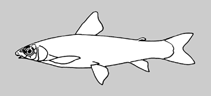
Rückenflossenweichstrahlen (insgesamt) : 11 - 12; Afterflossenweichstrahlen: 9 - 10; Wirbelzahl: 39 - 41. It differs from all congeners by possessing two ventrolateral rows of dark spots aligned along the horizontal lines where first and second and second and third scale rows below lateral-line scale row overlap (one or both rows of spots coalesce into narrow zigzag stripes in most specimens, upper row occasionally poorly developed); by possessing patches of dark pigment extending along the anal fin base and on the ventral midline of the caudal peduncle to the caudal fin base. Another distinguishing feature is the insertion of the first pterygiophore of the dorsal fin after vertebra 13 or 14 vs. 10 to 12 (rarely 13) in other species (reflected in a mean predorsal distance exceeding 0.50 of SL in A. gransabana vs. less than 0.50 in other species); distinguished from all congeners except A. guyanensis by the usual presence of 5 (occasionally 6) teeth (not counting replacement teeth) on each premaxillary bone vs. 4 in other species. Teeth of A. gransabana are gently convex with about 10-12 cusps, whereas those of A. guyanensis are spade-shaped with a highly convex margin and about 14-15 cusps, further differing from all congeners by the presence of 10-11 vertical scale rows vs. usually 9. A. gransabana has a notably more laterally compressed, parallel-sided body than its characteristically terete congeners (body width/dorsal-fin origin to pelvic-fin insertion distance less than 0.60 vs. usually 0.70 or more); and the isthmus is approximately one-half as wide; the caudal peduncle is more constricted (least depth/dorsal origin to pelvic-fin base distance averages 0.43 versus 0.450-0.570 or more in other species with ranges rarely overlapping).
Occurs in small streams mostly less than 10 m width in rocky areas with moderate to strong current. Schools of 20-40 individuals were found to swim in strong current near the substratum with a head-downward orientation. In reaches with moderate current, these fish usually swam higher above the substratum, and with more horizontal body orientation. Attains at least 9.2 cm SL.
Lebenszyklus und Paarungsverhalten
Geschlechtsreife | Fortpflanzung | Ablaichen | Eier | Fruchtbarkeit | Larven
Starnes, W.C. and I. Schindler, 1993. Comments on the genus Apareiodon Eigenmann (Characiformes: Parodontidae) with the description of a new species from the Gran Sabana Region of eastern Venezuela. Copeia 1993(3):754-762. (Ref. 10296)
IUCN Rote Liste Status (Ref. 130435: Version 2025-2 (Global))
Bedrohung für Menschen
Harmless
Nutzung durch Menschen
Tools
Zusatzinformationen
Download XML
Internet Quellen
Schätzungen auf der Grundlage von Modellen
Phylogenetischer Diversitätsindex (Ref.
82804): PD
50 = 0.5000 [Uniqueness, from 0.5 = low to 2.0 = high].
Bayesian length-weight: a=0.00676 (0.00306 - 0.01496), b=3.10 (2.91 - 3.29), in cm total length, based on LWR estimates for this (Sub)family-body shape (Ref.
93245).
Widerstandsfähigkeit (Ref.
120179): mittel, Verdopplung der Population dauert 1,4 - 4,4 Jahre. (Preliminary K or Fecundity.).
Anfälligkeit der Fischerei (Ref.
59153): Low vulnerability (10 of 100).
🛈