Taxonomic Remarks
Chinese common names from Ref. 31517 should correspond to the different species names seen in the book.
Ambiente: milieu / zona climatica / distribuzione batimetrica / gamma di distribuzione
Ecologia
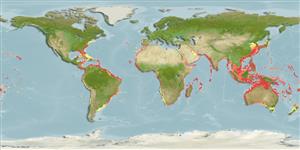
marino; salmastro associati a barriera corallina; distribuzione batimetrica 10 - 219 m (Ref. 9710), usually ? - 40 m (Ref. 5288). Subtropical; 43°N - 50°S, 88°W - 154°W (Ref. 57378)
Western Atlantic: off the coast of New Jersey (USA), Bermuda, Bahamas, Gulf of Mexico and throughout the island groups of the Caribbean to the southernmost coast of Brazil. Eastern Atlantic: off the African coast, from Senegal to Southwest Africa, with a single record from St. Helena. Indo-Pacific: Red Sea and the East African coast to the Society and Hawaiian islands, north to Japan, south to Australia and New Zealand.
Not in Eastern Pacific (Ref. 123477 ver. 09Nov2021).
Dimensione / Peso / Età
Maturità: Lm ? range ? - ? cm
Max length : 25.0 cm TL maschio/sesso non determinato; (Ref. 48635); common length : 10.0 cm TL maschio/sesso non determinato; (Ref. 3585); peso massimo pubblicato: 32.90 g (Ref. 118626)
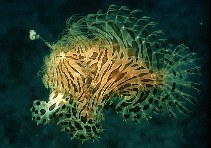
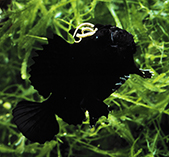
Spine dorsali (totale) : 3; Raggi dorsali molli (totale) : 11 - 12; Spine anali: 0; Raggi anali molli: 7. Diagnosis: body short and globose; mouth large with many small, villiform teeth; skin rough, covered with bifurcate dermal spinules; pectoral-fin lobes attached to sides of body; illicium at most as long as second dorsal-fin spine; head, body and fins entirely covered with rough, parallel, dark streaks (Ref. 57225).
Body shape (shape guide): short and / or deep; Cross section: compressed.
Inhabit rocky and coral reefs, on rocks, sand or rubble (Ref. 9710). Found in weedy estuaries along the east coast of southern Africa (Ref. 4113). Occurring in marine or brackish waters (Ref. 57225). In the Atlantic, it is found at an average depth of 40 m (Ref. 5288). Benthic (Ref. 58302). Observed to inflate itself greatly like the puffers (Ref. 5521). Oviparous. Males have more intense coloration and extended cutaneous appendages than females (Ref. 205). Eggs are bound in ribbon-like sheath or mass of gelatinous mucus called 'egg raft' or 'veil' (Ref. 6773).
Ciclo vitale e comportamento di accoppiamento
Maturità | Riproduzione | Deposizione | Uova | Fecondità | Larve
Oviparous. Males have more intense coloration and extended cutaneous appendages than females (Ref. 205). Eggs are bound in ribbon-like sheath or mass of gelatinous mucus called 'egg raft' or 'veil' (Ref. 6773).
Pietsch, T.W. and D.B. Grobecker, 1987. Frogfishes of the world. Systematics, zoogeography, and behavioral ecology. Stanford University Press, Stanford, California. 420 p. (Ref. 6773)
Stato della Lista Rossa IUCN (Ref. 130435: Version 2025-2 (Global))
Minaccia per l'uomo
Harmless
Usi umani
Pesca: di nessun interesse; Acquario: Commerciale
Strumenti
Rapporti speciali
Scarica XML
Fonti Internet
Stime basate su modelli
Temperatura preferita (Fonte Biblio.
123201): 18.2 - 28.6, mean 27 °C (based on 287 cells).
Indice di diversità filogenetica (Fonte Biblio.
82804): PD
50 = 0.5002 [Uniqueness, from 0.5 = low to 2.0 = high].
Bayesian length-weight: a=0.02692 (0.01067 - 0.06789), b=2.96 (2.73 - 3.19), in cm total length, based on LWR estimates for this (Sub)family-body shape (Ref.
93245).
Livello trofico (Fonte Biblio.
69278): 4.2 ±0.7 se; based on diet studies.
Resilienza (Fonte Biblio.
120179): Alto, tempo minimo di raddoppiamento della popolazione meno di 15 mesi (Fec = 73,000).
Vulnerabilità della pesca (Ref.
59153): Low vulnerability (15 of 100).
🛈
Nutrienti (Ref.
124155): Calcium = 26.8 [11.8, 72.2] mg/100g; Iron = 0.576 [0.292, 1.139] mg/100g; Protein = 19.7 [17.1, 23.0] %; Omega3 = 0.214 [0.076, 0.560] g/100g; Selenium = 15.7 [6.2, 38.7] μg/100g; VitaminA = 88.5 [18.8, 404.0] μg/100g; Zinc = 0.736 [0.437, 1.191] mg/100g (wet weight);