>
Cypriniformes (Carps) >
Leuciscidae (Minnows) > Leuciscinae
Etymology: Alburnus: From the city of Al Bura, where the fish was known (Ref. 45335).
Окружающая среда: среда / климатическая зона / пределы глубины / диапазон распространения
экология
; пресноводный; солоноватоводный донно-пелагический; мигрирует в реке (Ref. 51243). Temperate; 5°C - 20°C (Ref. 12468); 61°N - 38°N, 9°E - 55°E
Europe and Asia: Caspian (mostly western to southern coast, rarely found in Ural and Volga). Populations from Aral Sea basin might belong to this species (Ref. 59043). Reported from the Black Sea basin (Ref. 58342).
Размер / Вес / Возраст
половая зрелость: Lm ? range ? - ? cm
Max length : 40.0 cm TL самец/пол неопределен; (Ref. 556); common length : 20.0 cm TL самец/пол неопределен; (Ref. 1441); common length :28 cm TL (female)
Краткое описание
определительные ключи | морфология | морфометрия
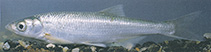
позвонки: 42 - 45. Diagnosed from its congeners in Caspian and Black Sea basin by having the following characters: anal fin origin about 1½ -2½ scales behind last branched dorsal ray; lateral line with 54-65 + 4-5 scales; anal fin rays with 13-15½ branched rays; 18-23 gill rakers; ventral keel exposed for 8-12 scales in front of anus (up to almost 80% of distance between anus and pelvic base); head length 20-24% SL; predorsal length 52-56% SL; caudal peduncle depth 1.9-2.4 times in its length; nuptial males with few, large tubercles; lacking dark midlateral stripe. Morphology is variable which has been considered to be an adaptation to different habitats, but data suggest that this is probably due to several species being confused under this species (Ref. 59043).
Body shape (shape guide): fusiform / normal.
Inhabit lower reaches of rives, coastal lakes, estuaries, and brackish areas of sea. Occur close to surface and tolerate salinities up to 14 ppt. Adults predominantly prey on planktonic crustaceans, terrestrial insects and small fish while larvae and young juveniles feed on zooplankton, algae and insect larvae. Spawn in small rivers or streams with heavy current on gravel bottom. Landlocked populations found in reservoirs spawn in reservoir tributaries (Ref. 59043). Eastern populations migrate upstream for spawning (Ref. 13696). Males assemble and wait at the spawning grounds for ripe females, which arrive later. Deposit sticky eggs which adhere on pebbles or stones. Embryonic development lasts 2-3 days, with larvae first staying among gravel for 8-11 days, then actively migrating to shallows and backwaters. Adults migrate back to sea, lakes or estuaries soon after spawning to forage. Young juvenile undertake downriver migration in autumn of same year or next spring. Due to dam constructions, almost all long-distance migrating populations lost as they were unable to reach spawning sites. Survive in small water courses and as landlocked populations in some reservoirs. Populations are expected to decline and to further decline due to expanding hydroelectric development and strong ecological impacts on Caspian sea (Ref. 59043).
Males assemble and wait at the spawning grounds for ripe females, which arrive later. Deposit sticky eggs which adhere on pebbles or stones. Embryonic development lasts 2-3 days, with larvae first staying among gravel for 8-11 days, then actively migrating to shallows and backwaters. Adults migrate back to sea, lakes or estuaries soon after spawning to forage. Young juvenile undertake downriver migration in autumn of same year or next spring (Ref. 59043).
Kottelat, M. and J. Freyhof, 2007. Handbook of European freshwater fishes. Publications Kottelat, Cornol and Freyhof, Berlin. 646 pp. (Ref. 59043)
Статус Красного Списка МСОП (Ref. 130435: Version 2025-2 (Global))
Угроза для людей
Harmless
Использование человеком
рыболовство: коммерческий; аквакультура (рыбоводство): коммерческий
дополнительная информация
инструменты
Специальные отчеты
Скачать в формате XML
ресурсы в Интернет
Оценки, основанные на моделях
Индекс филогенетического разнообразия (ссылка
82804): PD
50 = 0.5000 [Uniqueness, from 0.5 = low to 2.0 = high].
Bayesian length-weight: a=0.00617 (0.00515 - 0.00738), b=3.12 (3.09 - 3.15), in cm total length, based on LWR estimates for this species (Ref.
93245).
Трофический уровень (ссылка
69278): 3.4 ±0.41 se; based on food items.
устойчивость к внешним воздействиям (ссылка
120179): средний (среднего размера), минимальное время удвоения популяции 1.4-4.4 года (tm=2-5; tmax=9; K=0.10).
Уязвимость рыбной ловли (Ref.
59153): High vulnerability (63 of 100).
🛈