>
Blenniiformes (Blennies) >
Chaenopsidae (Pike-, tube- and flagblennies)
Etymology: Emblemariopsis: Latin, emblema = insertion, inlaid work, raised ornament + Greek, opsis = appearance (Ref. 45335).
Eponymy: Peter Bottome Deery (1937–2016) was a Venezuelan businessman. [...] (Ref. 128868), visit book page.
Ambiente: milieu / zona climática / intervalo de profundidade / gama de distribuição
Ecologia
marinhas associadas(os) a recifes; intervalo de profundidade ? - 40 m (Ref. 125603). Tropical
Western Central Atlantic: Caribbean Sea, from the Netherlands Antilles, Bonaire, and Curaçao); Venezuela; with a disjunct range in the Windward Lesser Antilles ending in Dominica, i.e. Tobago, St. Vincent, St. Lucia, Martinique, and Dominica.
Tamanho / Peso / Idade
Maturidade: Lm ? range ? - ? cm
Max length : 3.0 cm SL macho/indeterminado; (Ref. 125603)
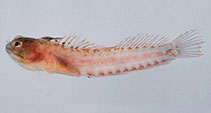
Espinhos dorsais (total) : 19 - 21; Raios dorsais moles (total) : 12 - 13; Espinhos anais: 2; Raios anais moles: 20 - 22. This species is without an orbital cirrus or a red banner and is distinguished by the following characters: TP territorial males found in holes with a black head; anterior dorsal fin is black, with a long, thin, white margin reaching well back to midfin; first dorsal-fin spine is short, when adpressed reaching up to 4th spine base, about 1/4 to 1/3 HL, the ubsequent spines rising to midfin spines; with a variable row of small dark spots along anterior lateral midline, irregular rows of dark spots along spinous-dorsal-fin membranes (Ref. 125603).
Dark-shaded, pale, and transitional TP have a short first dorsal-fin spine, when adpressed reaching up to 4th spine base, subsequent spines are rising to midfin with profile of anterior dorsal fin rising about linearly (except when transitional with dip for shorter fourth spine); the first two or three dorsal-fin membranes are white, followed by irregular row(s) of dark spots along spinous membranes; with a variable row of small dark spots along anterior lateral midline; opercular bands or lines are absent; reduced head markings, as a dark band from eye to across jaw, then paired white bands, on mid-upper jaw and just above, followed by an elongated dark moustache band above rear maxilla (Ref. 125603).
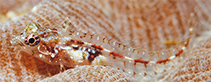
IP with elongated first two dorsal-fin spines, the first spine when adpressed reaching to base of 5th-8th spine base, the second spine slightly shorter, third about 1/2 of first, fourth shortest (juvenile, earlier IP, and approaching transition with less elongate spines). Colouration: live colors red, orange, and pink; cranial pattern with a pale or bluish oval or linear band 1 breaking up and reticulated with pieces of band 2, band 3 red ends of a broken-U band with a central Y, an extra pale spot behind band 3, a long pale band 4, and band 5 is inconspicuous; the IP head spots usually full complement; melanophores near pectoral-fin base one to three spots or a short oblique band (Ref. 125603).
Cross section: oval.
Observed TP males in holes in live and dead coral, as well as in sponges while IP fish are found perched on live corals and sponges, but also on dead coral and encrusted substrates; also the depth range is broad, up to at least 40 m with no particular peak of occurrence (Ref. 125603).
Ciclo de vida e comportamento de acasalamento
Maturidade | Reprodução | Desova | Ovos | Fecundidade | Larvas
Victor, B.C., 2020. Review of the glass blennies (Teleostei: Chaenopsidae: Emblemariopsis) with two new species from the Caribbean Sea. J. Ocean Sci. Found. 37:1-122. (Ref. 125603)
Categoria na Lista Vermelha da IUCN (Ref. 130435: Version 2025-2 (Global))
Ameaça para o homem
Harmless
Utilização humana
Ferramentas
Relatórios especiais
Descarregue XML
Fontes da internet
Estimativas baseadas em modelos
Índice de diversidade filogenética (Ref.
82804): PD
50 = 0.5001 [Uniqueness, from 0.5 = low to 2.0 = high].
Bayesian length-weight: a=0.00525 (0.00224 - 0.01232), b=3.07 (2.86 - 3.28), in cm total length, based on LWR estimates for this (Sub)family-body shape (Ref.
93245).
Nível Trófico (Ref.
69278): 3.3 ±0.5 se; based on size and trophs of closest relatives
Vulnerabilidade da pesca (Ref.
59153): Low vulnerability (10 of 100).
🛈