>
Siluriformes (Catfishes) >
Mochokidae (Squeakers or upside-down catfishes) > Mochokinae
Etymology: Synodontis: Greek, syn, symphysis = grown together + Greek, odous = teeth (Ref. 45335).
More on author: Rüppell.
Taxonomic Remarks
Reassigned to Synodontis based on a phylogenetic study (Ref. 79014). This species is placed in the genus Brachysynodontis in Eschmeyer (CofF ver. Mar. 2011: Ref. 86697).
Meio ambiente: milieu / Zona climática / intervalo de profundidade / faixa de distribuição
Ecologia
; Água doce bentopelágico; potamódromo (Ref. 138143). Tropical; 23°C - 27°C (Ref. 12468); 35°N - 4°N
Africa: Nile (Ref. 7362, 28714), Senegal, Gambia, upper Volta (Ref. 57223), Ogun (Ref. 31256), Osse, Niger (including the Bénoué) and Chad basins (Ref. 57223).
Comprimento de primeira maturação / Tamanho / Peso / Idade
Maturidade: Lm ?, range 13 - ? cm
Max length : 28.6 cm TL macho/indeterminado; (Ref. 130826); peso máx. publicado: 1.5 kg (Ref. 3799)
Espinhos dorsais (total) : 1; Espinhos anais: 0. Diagnosis: gill slits extending downwards beyond pectoral-fin insertions, but remaining separate by an interval greater than eye diameter; maxillary barbels not longer than head, without tubercles or ramifications, but with a broad black membrane almost extending over their entire length; mandibular barbels without membrane; ramifications of outer mandibular barbels few and simple, those of inner mandibular barbels more numerous and subdivided; mandibular teeth slender and short, numbering 30-57; pectoral-fin spines more strongly denticulate on inner than on outer margin; anterior margin of dorsal-fin spine smooth, except for some apical serrations; humeral process rather deep, granulose and weakly keeled ventrally; adipose fin high and almost contiguous to rayed dorsal fin (proportionately
less high in young individuals)(Ref. 57223).
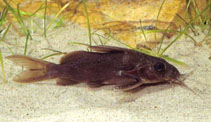
Coloration: typically an inverted colour pattern, the back being light grey and the belly black; pelvics, anal and caudal fins always covered with transversely aligned spots; other spots also tend to form transverse series, but these are not as well-defined; maxillary barbels bordered by a broad, black membrane (Ref. 57223).
Body shape (shape guide): fusiform / normal.
Omnivore. Adults feed on plankton, algae and detritus (Ref. 13868). May also feed on surface insects, chironomid larvae, benthic crustaceans and mollusks (Ref. 28714). Oviparous (Ref. 205). Maximum size reported as 50.0cm total length in Ref. 3799, but only 26.5cm total length in Ref. 57223.
Ciclo de vida ou comportamento de acasalamento
Maturidade | Reprodução | Desova | Ovos | Fecundidade | Larvas
Oviparous (Ref. 205). Distinct pairing during breeding (Ref. 205).
Paugy, D. and T.R. Roberts, 2003. Mochokidae. p. 195-268 In C. Lévêque, D. Paugy and G.G. Teugels (eds.) Faune des poissons d'eaux douce et saumâtres de l'Afrique de l'Ouest, Tome 2. Coll. Faune et Flore tropicales 40. Musée Royal de l'Afrique Centrale, Tervuren, Belgique, Museum National d'Histoire Naturalle, Paris, France and Institut de Recherche pour le Développement, Paris, France. 815 p. (Ref. 57223)
Status na Lista Vermelha da UICN (Ref. 130435: Version 2025-2 (Global))
Uso pelos humanos
Pescarias: espécies comerciais; Aquário: Espécies comerciais
Ferramentas
Relatórios especiais
Baixar XML
Fontes da internet
Estimativas baseadas em modelos
Índice de diversidade filogenética (Ref.
82804): PD
50 = 0.5000 [Uniqueness, from 0.5 = low to 2.0 = high].
Bayesian length-weight: a=0.01698 (0.01002 - 0.02880), b=2.98 (2.84 - 3.12), in cm total length, based on LWR estimates for this species & Genus-body shape (Ref.
93245).
Nível Trófico (Ref.
69278): 2.8 ±0.33 se; based on food items.
Generation time: 5.9 ( na - na) years. Estimated as median ln(3)/K based on 1
growth studies.
Resiliência (Ref.
120179): médio(a), tempo mínimo de duplicação da população 1,4 - 4,4 anos (Preliminary K or Fecundity.).
Vulnerabilidade da pesca (Ref.
59153): Moderate vulnerability (39 of 100).
🛈