>
Siluriformes (Catfishes) >
Claroteidae (Claroteid catfishes)
Etymology: Clarotes: Greek, klarotes, a term for slaves, people with bent necks; in reference to the morphology of the head.
More on author: Rüppell.
Taxonomic Remarks
The taxonomic status of the Kenyan populations is uncertain and needs detailed study (Ref. 52331).
Ambiente: milieu / zona climática / intervalo de profundidade / gama de distribuição
Ecologia
; Água doce demersal; anádromo (Ref. 51243). Tropical; 20°C - 26°C (Ref. 2059); 17°N - 3°N
Africa: present in all Nilo-Sudanese basins, including Chad, Benue, Niger, Senegal, and Volta (Ref. 57126). Also in East Africa and Nile basin (Ref. 3236, 28714).
Comprimento na primeira maturidade / Tamanho / Peso / Idade
Maturidade: Lm ?, range 28 - ? cm
Max length : 80.0 cm SL macho/indeterminado; (Ref. 4967); peso máx. Publicado: 10.0 kg (Ref. 3799)
Descrição breve
Chaves de identificação | Morfologia | Morfometria
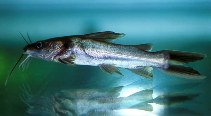
Espinhos dorsais (total) : 2; Raios dorsais moles (total) : 5 - 7; Espinhos anais: 0. Diagnosis: adipose fin rayed in adults, 1st ray forming a spine (not visible in juveniles); adipose-fin rays becoming visible at sizes of 90-100 mm SL, and the spine at 200 mm; dentition very well developed: premaxillary tooth plate broad (38-45% of head length), palatine dentition consisting of an elongate vomerine plate and of a dermo-palatine plate in young individuals (60-70 mm SL); palatine tooth plates narrow and long with much weaker dentition; nasal barbel long, reaching at least to anterior part of orbit; maxillary barbel very long, exceeding at least the anterior part of dorsal fin and often reaching to adipose fin; caudal-fin lobes marked by a dark band; cranial bones well developed; length of occipital process usually less than 1.4 times its width (Ref. 57126).
Body shape (shape guide): elongated; Cross section: circular.
Inhabits rivers (Ref 4967). Feeds on crustaceans, insects, mollusks and fish (Ref. 28714).
Ciclo de vida e comportamento de acasalamento
Maturidade | Reprodução | Desova | Ovos | Fecundidade | Larvas
Risch, L.M., 2003. Claroteidae. p. 60-96 In C. Lévêque, D. Paugy and G.G. Teugels (eds.) Faune des poissons d'eaux douce et saumâtres de l'Afrique de l'Ouest, Tome 2. Coll. Faune et Flore tropicales 40. Musée Royal de l'Afrique Centrale, Tervuren, Belgique, Museum National d'Histoire Naturalle, Paris, France and Institut de Recherche pour le Développement, Paris, France. 815 p. (Ref. 57126)
Categoria na Lista Vermelha da IUCN (Ref. 130435: Version 2025-2 (Global))
Ameaça para o homem
Harmless
Utilização humana
Pescarias: espécies comerciais
Ferramentas
Relatórios especiais
Descarregue XML
Fontes da internet
Estimativas baseadas em modelos
Índice de diversidade filogenética (Ref.
82804): PD
50 = 0.7500 [Uniqueness, from 0.5 = low to 2.0 = high].
Bayesian length-weight: a=0.01380 (0.00734 - 0.02597), b=3.02 (2.85 - 3.19), in cm total length, based on LWR estimates for this species & (Sub)family-body (Ref.
93245).
Nível Trófico (Ref.
69278): 3.1 ±0.43 se; based on food items.
Resiliência (Ref.
120179): Médio, tempo mínimo de duplicação da população 1,4 - 4,4 anos (Preliminary K or Fecundity.).
Vulnerabilidade da pesca (Ref.
59153): High vulnerability (59 of 100).
🛈