>
Gobiiformes (Gobies) >
Gobiidae (Gobies) > Gobionellinae
Etymology: Pandaka: Sanskrit, pandaka = without testicles, hermaphrodite, homosexual; it is a Philippines fish, the smallest of the world.
More on author: Herre.
Entorno: milieu / zona climática / rango de profundidad / gama de distribución
Ecología
marino; agua dulce; salobre demersal; pH range: 7.0 - 8.4; dH range: ? - 30; anfidromo (Ref. 46888); rango de profundidad 0 - 2 m (Ref. 90102). Tropical; 24°C - 30°C (Ref. 2060)
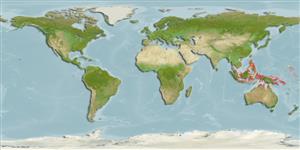
Asia: Indonesia and Philippines. Originally reported from the Malabon River, Rizal, Philippines, which has meanwhile been reclaimed. According to Ref. 6216 it has also been collected in the sea at Culion Island, off Palawan, Philippines. Recently collected in Bali (1991), Sulawesi (1988), and Singapore (1992), M. Kottelat, pers. comm.
Longitud en la primera madurez / Tamaño / Peso / Edad
Madurez: Lm 1.0, range 1 - 1.1 cm
Max length : 1.1 cm SL macho / no sexado; (Ref. 2060); 1.5 cm TL (female)
Descripción breve
Claves de identificación | Morfología | Morfometría
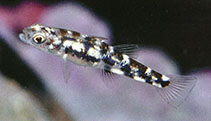
Espinas dorsales (total) : 7; Radios blandos dorsales (total) : 6 - 7; Espinas anales: 1; Radios blandos anales: 6 - 7. Dark spots on sides of body somewhat forming 4 cross-bands; heavy pigmentations on all bases of fins, except ventrals, apparently are continuation of body pigmentation. Head and nape naked. 22 to 25 scales in longitudinal series (Ref. 4924); further characterized by presence of black spot at middle of caudal fin base; first dorsal fin yellowish with black anterior; rounded caudal fin (Ref. 90102).
Body shape (shape guide): fusiform / normal; Cross section: oval.
This is one of the smallest freshwater fishes: males are mature at 9 mm, females at 15 mm. The species used to frequent shady river banks in the Malabon River, Rizal Province, Luzon, Philippines; however, the type locality has been reclaimed and the remaining waters in the area are heavily polluted; the species is considered extinct in the Philippines (Rainer Froese, pers. comm., 2004). It has been apparently imported into Germany in 1958; a color photo of the fish was taken in an aquarium (Ref. 2060). Found in brackish waters and mangrove areas of Indonesia (M. Kottelat, pers. comm.).
Ciclo vital y comportamiento de apareamiento
Madurez | Reproducción | Puesta | Huevos | Fecundidad | Larva
Probably a non-guarder (RF).
Larson, H.K., 2001. A revision of the gobiid fish genus Mugilogobius (Teleostei: Gobioidei), and its systematic placement. Rec. West. Aust. Mus. (Suppl. No. 62):1-233. (Ref. 43716)
Situación en la Lista Roja de la UICN (Ref. 130435: Version 2025-2 (Global))
Amenaza para el ser humano
Harmless
Usos humanos
Pesquerías: sin interés
Herramientas
Informes especiales
Descargar XML
Fuentes de Internet
Estimaciones basadas en modelos
Temperatura preferida (Referencia
123201): 27.6 - 29.2, mean 28.8 °C (based on 873 cells).
Índice de diversidad filogenética (Referencia
82804): PD
50 = 0.5078 [Uniqueness, from 0.5 = low to 2.0 = high].
Bayesian length-weight: a=0.01023 (0.00452 - 0.02316), b=3.00 (2.81 - 3.19), in cm total length, based on LWR estimates for this (Sub)family-body shape (Ref.
93245).
Nivel trófico (Referencia
69278): 2.9 ±0.4 se; based on size and trophs of closest relatives
Resiliencia (Referencia
120179): Alto, población duplicada en un tiempo mínimo inferior a 15 meses (Preliminary K or Fecundity.).
Vulnerabilidad pesquera (Ref.
59153): Low vulnerability (10 of 100).
🛈