Environnement : milieu / zone climatique / profondeur / gamme de distribution
Écologie
; eau douce; saumâtre pélagique. Tropical; 11°N - 1°S, 64°W - 46°W (Ref. 189)
Central and South America: lower parts of rivers from Trinidad and eastern Venezuela south to Para, Brazil.
Taille / Poids / Âge
Maturité: Lm ? range ? - ? cm
Max length : 15.0 cm TL mâle / non sexé; (Ref. 12225); common length : 8.0 cm TL mâle / non sexé; (Ref. 5217)
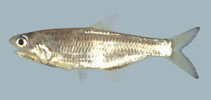
Épines dorsales (Total) : 0; Épines anales: 0; Rayons mous anaux: 20 - 25. Snout moderate and pointed, tip well above center of eye; maxilla short, tip blunt, failing to reach articulation of lower jaw by about 1/3 eye diameter, not extending behind end of second supra-maxilla; sub-operculum with angular hind margin, not formed into a triangular projection; gill rakers fine and slender. Silver stripe along flank, up to 1.5 eye diameter at widest (Ref. 189). Lacks membrane connecting the gill covers across the isthmus, longer and narrower cheek, higher dorsal and longer pectoral. Deep body and numerous gill rakers (Ref. 37032).
Body shape (shape guide): elongated; Cross section: compressed.
Occurs in estuaries and rivers to collect food. At certain months of the year, mainly Feb.-Mar., this fish is very abundant and forms an important part of the fisheries (Ref. 12225).
Cycle de vie et comportement reproducteur
Maturité | Reproduction | Frai | Œufs | Fécondité | Larves
Spawn in school (Ref. 205).
Whitehead, P.J.P., G.J. Nelson and T. Wongratana, 1988. FAO Species Catalogue. Vol. 7. Clupeoid fishes of the world (Suborder Clupeoidei). An annotated and illustrated catalogue of the herrings, sardines, pilchards, sprats, shads, anchovies and wolf-herrings. FAO Fish. Synop. 125(7/2):305-579. Rome: FAO. (Ref. 189)
Statut dans la liste rouge de l'IUCN (Ref. 130435: Version 2025-2 (Global))
Menace pour l'homme
Harmless
Utilisations par l'homme
Pêcheries: pêcheries vivrières
Outils
Articles particuliers
Télécharger en XML
Sources Internet
Estimations basées sur des modèles
Indice de diversité phylogénétique (Réf.
82804): PD
50 = 0.5625 [Uniqueness, from 0.5 = low to 2.0 = high].
Bayesian length-weight: a=0.00631 (0.00361 - 0.01104), b=3.13 (2.98 - 3.28), in cm total length, based on LWR estimates for this species & (Sub)family-body (Ref.
93245).
Niveau trophique (Réf.
69278): 3.0 ±0.4 se; based on size and trophs of closest relatives
Generation time: 1.6 ( na - na) years. Estimated as median ln(3)/K based on 1
growth studies.
Résilience (Réf.
120179): Haut, temps minimum de doublement de population inférieur à 15 mois (Preliminary K or Fecundity.).
Vulnérabilité de la pêche (Ref.
59153): Low vulnerability (20 of 100).
🛈