>
Lophiiformes (Anglerfishes) >
Oneirodidae (Dreamers)
Etymology: Leptacanthichthys: Greek, 'leptos' = thin or delicate + Greek, 'akantha' = thorn or spine + Greek, 'ichthys' = fish; a "thin-spined fish"; referring to the unusually thin, delicate illicium.
More on author: Regan.
Milieu: milieu / Klimaatzone / Diepte / verspreidingsgebied
Ecologie
marien bathypelagisch; diepte 0 - 2000 m (Ref. 5951), usually 1000 - ? m (Ref. 12204). Deep-water
North Atlantic: including Canada. Also Pacific Ocean.
Grootte / Gewicht / Leeftijd
Maturiteit: Lm ? range ? - ? cm
Max length : 0.8 cm SL mannelijk / geslacht onbekend; (Ref. 12204); 6.9 cm SL (female)
Korte beschrijving
Determinatiesleutels | Morfologie | Morfometrie
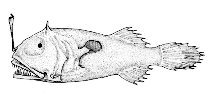
Dorsale zachte stralen (totaal) : 4 - 6; Anale zachte stralen: 5 - 6. Unique among dreamers in having a well-developed mandibular spine and a very elongate and narrow pectoral fin lobe (Ref. 12204). Dark in color, with the esca unpigmented in patches (Ref.12204). Metamorphosed females distinguished by the following characteristics: extremely well developed articular spine, considerably longer than quadrate spine; wide ethmoid cartilage and vomer, wider than distance between anterolateral tips of lateral ethmoids and frontals; presence of vomerine teeth; depressed ethmoid region, nasal foramina narrow and oval in shape; long frontals, anterior in posterior, overhanging and extending past the anterior limits of ethmoid cartilage and vomer; nearly linear dorsal margins of frontals; ; ventromedial extensions of frontals approach each other on midline, making contact with parasphenoid; frontals separated from prootics; presence of pterosphenoid; anterior end of illicial trough wider and shallower than posterior end; extremely well developed sphenotic spines; symphysial cartilage of upper jaw longer than wide; lower jaw with small symphysial spine; hyomandibula with double head; ; deeply notched posterior margin of opercle; short and broad subopercle, dorsal end rounded to bluntly pointed, ventral end rounded; absence of first pharyngobranchial; well developed second pharyngobranchial; second hypobranchial directly articulates with second basibranchial; caudal fin rays without internal pigmentation; illicium longer than length of esca bulb; pterygoiphore of illicium cylindrical throughout its length, emerging on snout from between frontal bones, anterior end slightly exposed, posterior end concealed beneath skin; well developed first ray of dorsal fin; dorsal fin rays 4-6; anal fin rays 5; long and narrow pectoral fin lobe, longer than longest rays of pectoral fin; pectoral fin rays 18-22; coracoid lacking posteroventral process; simple pelvic bones, expanded distally; skin is naked, without dermal spinules; darkly pigmented skin of caudal peduncle extends well past base of caudal fin (Ref. 86949). Metamorphosed males: long and narrow pectoral fin lobe, longer than longest pectoral fin rays, articulating along the dorsal margin; short and broad subopercle, dorsal end rounded; lower denticular teeth 6; naked skin, without dermal spinules (Ref. 86949).
Body shape (shape guide): short and / or deep.
Deep-sea species (Ref. 12204). Males parasitic on the females (Ref. 12204).
Levenscyclus en paargedrag
Maturiteit | Voortplanting | Paaien | Eieren | Fecunditeit | Larven
Coad, B.W., 1995. Encyclopedia of Canadian fishes. Canadian Museum of Nature and Canadian Sportfishing Productions Inc. Singapore. (Ref. 12204)
Status op de Rode Lijst van het IUCN (Ref. 130435: Version 2025-2 (Global))
Gevaar voor de mens
Harmless
Gebruik door de mens
Visserij: van geen belang
Tools
Speciale rapporten
Download XML
Internetbronnen
Schattingen op basis van modellen
Gewenste temperatuur (Ref.
123201): 0.2 - 5.4, mean 3.6 °C (based on 1622 cells).
Fylogenetische diversiteitsindex (Ref.
82804): PD
50 = 1.0000 [Uniqueness, from 0.5 = low to 2.0 = high].
Bayesian length-weight: a=0.01995 (0.00906 - 0.04395), b=3.01 (2.83 - 3.19), in cm total length, based on all LWR estimates for this body shape (Ref.
93245).
Trofisch niveau (Ref.
69278): 3.7 ±0.6 se; based on size and trophs of closest relatives
Weerstandsvermogen (Ref.
120179): Hoog, minimale populatieverdubbelingstijd minder dan 15 maanden (Preliminary K or Fecundity.).
Kwetsbaarheid van de visserij (Ref.
59153): Low vulnerability (10 of 100).
🛈