>
Blenniiformes (Blennies) >
Tripterygiidae (Triplefin blennies) > Tripterygiinae
Etymology: Tripterygion: Greek, tres tria = three + Greek, pteron = wing, fin; diminutive (Ref. 45335).
More on author: Guichenot.
Ambiente: milieu / zona climática / intervalo de profundidade / gama de distribuição
Ecologia
marinhas demersal; intervalo de profundidade 3 - 40 m. Subtropical; 40°N - 30°N, 1°E - 36°E
Mediterranean Sea: Balearic Islands (Spain), southern Sardinia, Algeria, Tunisia, Israel, Lebanon, Cyprus, and southern Turkey.
Tamanho / Peso / Idade
Maturidade: Lm ? range ? - ? cm
Max length : 5.3 cm TL macho/indeterminado; (Ref. 4785); 4.5 cm NG (female)
Descrição breve
Chaves de identificação | Morfologia | Morfometria
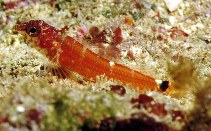
Espinhos dorsais (total) : 17 - 19; Raios dorsais moles (total) : 10 - 13; Espinhos anais: 2; Raios anais moles: 22 - 25. Body permanently red in color, females and non-territorial males with marbled head; in territorial males black; slightly dark, vertical bars, often white spots and bars along back (Ref. 4785). Territorial males with prolonged rays in second dorsal (Ref. 4785).
Adults inhabit dimly-lit areas, clinging to walls or ceilings (Ref. 4785). They feed on small invertebrates, especially harpacticoids (Ref. 4785). Eggs are hemispherical and covered with numerous sticky threads that anchor them in the algae on the nesting sites (Ref. 240). Larvae are planktonic which occur primarily in shallow, nearshore waters (Ref. 94114).
Ciclo de vida e comportamento de acasalamento
Maturidade | Reprodução | Desova | Ovos | Fecundidade | Larvas
Several females lay eggs on substrate of males' territory, often on sponges; eggs are guarded by the male (Ref. 4785).
Zander, C.D., 1986. Tripterygiidae. p. 1118-1121. In P.J.P. Whitehead, M.-L. Bauchot, J.-C. Hureau, J. Nielsen and E. Tortonese (eds.) Fishes of the North-eastern Atlantic and the Mediterranean, . UNESCO, Paris. Vol. 3. (Ref. 4785)
Categoria na Lista Vermelha da IUCN (Ref. 130435: Version 2025-2 (Global))
Ameaça para o homem
Harmless
Utilização humana
Ferramentas
Relatórios especiais
Descarregue XML
Fontes da internet
Estimativas baseadas em modelos
Temperatura preferida (Ref.
123201): 17.1665 - 18.7235, mean 17.945 °C (based on 2 cells).
Índice de diversidade filogenética (Ref.
82804): PD
50 = 0.5625 [Uniqueness, from 0.5 = low to 2.0 = high].
Bayesian length-weight: a=0.00617 (0.00290 - 0.01310), b=3.04 (2.86 - 3.22), in cm total length, based on LWR estimates for this (Sub)family-body shape (Ref.
93245).
Nível Trófico (Ref.
69278): 3.5 ±0.37 se; based on food items.
Resiliência (Ref.
120179): Elevada, tempo mínimo de duplicação da população menor que 15 meses (Preliminary K or Fecundity.).
Vulnerabilidade da pesca (Ref.
59153): Low vulnerability (10 of 100).
🛈
Nutrientes (Ref.
124155): Calcium = 592 [272, 2,129] mg/100g; Iron = 3.3 [1.4, 7.7] mg/100g; Protein = 18.3 [16.8, 19.7] %; Omega3 = 0.272 [0.088, 0.842] g/100g; Selenium = 44 [11, 143] μg/100g; VitaminA = 7.86 [1.39, 46.35] μg/100g; Zinc = 2.52 [1.26, 4.45] mg/100g (wet weight);