>
Eupercaria/misc (Various families in series Eupercaria) >
Malacanthidae (Tilefishes)
Etymology: Hoplolatilus: Greek, hoplon = weapon + Latin, latus = wide (Ref. 45335).
Eponymy: John Frederick Pohle (1935–2016) was a US Airforce officer and research scuba diver. [...] (Ref. 128868), visit book page.
Environnement : milieu / zone climatique / profondeur / gamme de distribution
Écologie
marin récifal; non migrateur (Ref. 52884); profondeur 40 - 90 m (Ref. 32518). Tropical
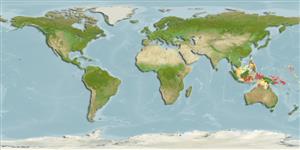
Western Pacific: Indonesia and Papua New Guinea.
Taille / Poids / Âge
Maturité: Lm ? range ? - ? cm
Max length : 11.0 cm SL (female)
Description synthétique
Clés d'identification | Morphologie | Morphométrie
Épines dorsales (Total) : 10; Rayons mous dorsaux (Total) : 13; Épines anales: 2; Rayons mous anaux: 12.
Body shape (shape guide): fusiform / normal; Cross section: compressed.
Pairs hovering within a meter above the bottom were observed. Sometimes solitary (Ref 90102).
Cycle de vie et comportement reproducteur
Maturité | Reproduction | Frai | Œufs | Fécondité | Larves
Displays obligate monogamy where a one-to-one pair is established irrespective of resource abundance (Ref. 52884).
Earle, J.L. and R. Pyle, 1997. Hoplolatilus pohle, a new species of sand tilefish (Perciformes: Malacanthidae) from the deep reefs of the D'Entrecasteaux Islands, Papua New Guinea. Copeia 1997(2):382-387. (Ref. 32518)
Statut dans la liste rouge de l'IUCN (Ref. 130435: Version 2025-2 (Global))
Menace pour l'homme
Harmless
Utilisations par l'homme
Pêcheries: d'intérêt potentiel
Outils
Articles particuliers
Télécharger en XML
Sources Internet
Estimations basées sur des modèles
Température préférée (Réf.
123201): 26.8 - 28.7, mean 27.4 °C (based on 75 cells).
Indice de diversité phylogénétique (Réf.
82804): PD
50 = 0.5001 [Uniqueness, from 0.5 = low to 2.0 = high].
Bayesian length-weight: a=0.01122 (0.00514 - 0.02450), b=3.04 (2.87 - 3.21), in cm total length, based on all LWR estimates for this body shape (Ref.
93245).
Niveau trophique (Réf.
69278): 3.4 ±0.4 se; based on size and trophs of closest relatives
Vulnérabilité de la pêche (Ref.
59153): Low vulnerability (10 of 100).
🛈