Klassifizierung / Names
Namen | Synonyme | Catalog of Fishes(Gattung, Arten) | ITIS | CoL | WoRMS | Cloffa
>
Ophidiiformes (Cusk eels) >
Ophidiidae (Cusk-eels) > Neobythitinae
Etymology: Monomitopus: Greek, monos = one + Greek, mitos, -ou = sting of a lyre + Greek, pous = foot (Ref. 45335).
More on authors: Carter & Cohen.
Umwelt: Milieu / Klimazone / Tiefenbereich / Verbreitungsgebiet
Ökologie
seewasser bathydemersal; tiefenbereich 730 - 930 m (Ref. 34024). Deep-water; 5°C - 10°C (Ref. 31446); 30°N - 23°N
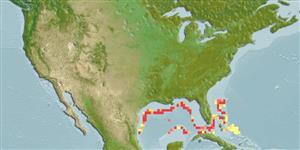
Western Atlantic: off eastern Florida, off northern Cuba, and in the eastern Gulf of Mexico off the Florida Keys.
Größe / Gewicht / Alter
Geschlechtsreife: Lm ? range ? - ? cm
Max length : 53.5 cm SL Männchen/unbestimmt; (Ref. 31446)
Rückenflossenweichstrahlen (insgesamt) : 104 - 108; Afterflossenweichstrahlen: 85 - 92.
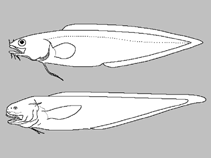
Body shape (shape guide): elongated.
Uncommon species (Ref. 34024). Feed on euphausiid shrimps, gammarid amphipods, fish scales and a midwater myctophid (Ref. 31446). Feeding probably takes place on or just above the bottom, utilizing both benthic and benthopelagic crustaceans and fishes (Ref. 31446). Reproductive strategy possibly similar to other members of this family featuring oviparity, with oval pelagic eggs floating in a gelatinous mass (Ref. 205).
Lebenszyklus und Paarungsverhalten
Geschlechtsreife | Fortpflanzung | Ablaichen | Eier | Fruchtbarkeit | Larven
Nielsen, J.G., D.M. Cohen, D.F. Markle and C.R. Robins, 1999. Ophidiiform fishes of the world (Order Ophidiiformes). An annotated and illustrated catalogue of pearlfishes, cusk-eels, brotulas and other ophidiiform fishes known to date. FAO Fish. Synop. 125(18):178p. Rome: FAO. (Ref. 34024)
IUCN Rote Liste Status (Ref. 130435: Version 2025-2 (Global))
Bedrohung für Menschen
Harmless
Nutzung durch Menschen
Fischereien: nicht kommerziell
Tools
Zusatzinformationen
Download XML
Internet Quellen
Schätzungen auf der Grundlage von Modellen
Bevorzugte Temperatur (Ref.
123201): 5.7 - 9.3, mean 8.8 °C (based on 8 cells).
Phylogenetischer Diversitätsindex (Ref.
82804): PD
50 = 0.5000 [Uniqueness, from 0.5 = low to 2.0 = high].
Bayesian length-weight: a=0.00380 (0.00165 - 0.00876), b=3.14 (2.93 - 3.35), in cm total length, based on LWR estimates for this (Sub)family-body shape (Ref.
93245).
Trophische Ebene (Ref.
69278): 3.8 ±0.62 se; based on food items.
Widerstandsfähigkeit (Ref.
120179): mittel, Verdopplung der Population dauert 1,4 - 4,4 Jahre. (Preliminary K or Fecundity.).
Anfälligkeit der Fischerei (Ref.
59153): Moderate to high vulnerability (46 of 100).
🛈