Entorno: milieu / zona climática / rango de profundidad / gama de distribución
Ecología
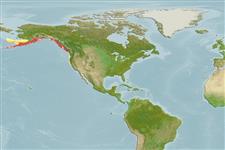
marino demersal; no migratorio (Ref. 87495); rango de profundidad 6 - 128 m (Ref. 12204). Temperate; 60°N - 38°N, 175°W - 120°W
Northeast Pacific: southeast Bering Sea to northern California, USA.
Tamaño / Peso / Edad
Madurez: Lm ? range ? - ? cm
Max length : 117 cm TL macho / no sexado; (Ref. 12204)
Descripción breve
Claves de identificación | Morfología | Morfometría
Espinas dorsales (total) : 72 - 77; Radios blandos dorsales (total) : 0; Espinas anales: 2; Radios blandos anales: 43 - 49. Pale brown in color, with touches of yellow or violet (Ref. 12204).
Body shape (shape guide): elongated.
Found on soft bottoms (Ref. 12204). Probably spends part of its life buried (Ref. 12204).
Ciclo vital y comportamiento de apareamiento
Madurez | Reproducción | Puesta | Huevos | Fecundidad | Larva
Coad, B.W., 1995. Encyclopedia of Canadian fishes. Canadian Museum of Nature and Canadian Sportfishing Productions Inc. Singapore. (Ref. 12204)
Situación en la Lista Roja de la UICN (Ref. 130435: Version 2025-2 (Global))
Amenaza para el ser humano
Harmless
Usos humanos
Herramientas
Informes especiales
Descargar XML
Fuentes de Internet
Estimaciones basadas en modelos
Temperatura preferida (Referencia
123201): 4.1 - 10.1, mean 6.8 °C (based on 180 cells).
Índice de diversidad filogenética (Referencia
82804): PD
50 = 0.6250 [Uniqueness, from 0.5 = low to 2.0 = high].
Bayesian length-weight: a=0.00389 (0.00180 - 0.00842), b=3.12 (2.94 - 3.30), in cm total length, based on all LWR estimates for this body shape (Ref.
93245).
Nivel trófico (Referencia
69278): 3.1 ±0.1 se; based on size and trophs of closest relatives
Vulnerabilidad pesquera (Ref.
59153): High to very high vulnerability (70 of 100).
🛈