>
Cypriniformes (Carps) >
Cyprinidae (Minnows or carps) > Labeoninae
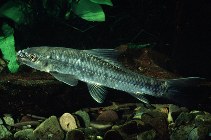
Etymology: Labeo: Latin, labeo = one who has large lips (Ref. 45335); cylindricus: From the Latin cylindrus - cylinder, name refers to the cylindrical form of the body (Ref. 26192).
More on author: Peters.
Milieu: milieu / Klimaatzone / Diepte / verspreidingsgebied
Ecologie
; zoet water benthopelagisch; potamodroom (Ref. 51243); diepte 30 - 30 m. Tropical; 24°C - 28°C (Ref. 2059); 10°N - 28°S
Africa: within the drainage basins of the Zambezi, Limpopo, Incomati and Usutu-Pongolo Rivers (Ref. 1440). In the Congo Basin, its distribution is limited to the middle and upper regions (Ref. 26192). Also known from East African rivers and the region of the Cap; south through the Zambezi system (Ref. 7248, 52193) and in the Coroca and Cuanza rivers in Angola (Ref. 11970).
Grootte / Gewicht / Leeftijd
Maturiteit: Lm ? range ? - ? cm
Max length : 25.0 cm SL mannelijk / geslacht onbekend; (Ref. 94784); max. gepubliceerd gewicht: 900.00 g (Ref. 52193)
Dorsale stekels (totaal) : 0; Dorsale zachte stralen (totaal) : 12 - 13; Anale stekels: 0; Anale zachte stralen: 8; Wervels: 29 - 31. Diagnosis: Lips plicate; dorsal fin concave with 9 to 10 branched rays; eyes in superolateral position; genital orifice very far from origin of anal fin; body cylindrical, slightly elongated; snout truncate with deep transverse furrow and fleshy appendix directed upwards (Ref. 26192).
Body shape (shape guide): fusiform / normal; Cross section: oval.
Shoaling species (Ref. 94784). Found in both sediment-free and sediment-rich rocky biotopes; favors clear, running waters in rocky habitats of small and large rivers, also found in lakes and dams over rocky areas (Ref. 5595, 52193). It feeds on diatoms and other small algae from the rocks (Ref. 5595), also on `aufwuchs' from the surface of rocks, tree trunks and other firm surfaces (Ref. 52193). Migrates upstream in masses to breed, using the mouth and broad pectoral fins to climb damp surfaces of barrier rocks and weirs (Ref. 7248, 52193). Some sources give a maximum length of 400 mm standard length (Ref. 2801)
Levenscyclus en paargedrag
Maturiteit | Voortplanting | Paaien | Eieren | Fecunditeit | Larven
Reid, G.M., 1985. A revision of African species of Labeo (Pisces: Cyprinidae) and a re-definition of the genus. Verlag von J. Cramer, Braunschweig. 322 p. (Ref. 1440)
Status op de Rode Lijst van het IUCN (Ref. 130435: Version 2025-2 (Global))
Gevaar voor de mens
Harmless
Gebruik door de mens
Visserij: commercieel; Aquarium: Commercieel
Tools
Speciale rapporten
Download XML
Internetbronnen
Schattingen op basis van modellen
Fylogenetische diversiteitsindex (Ref.
82804): PD
50 = 0.5000 [Uniqueness, from 0.5 = low to 2.0 = high].
Bayesian length-weight: a=0.00955 (0.00546 - 0.01671), b=3.05 (2.90 - 3.20), in cm total length, based on LWR estimates for this species & Genus-body shape (Ref.
93245).
Trofisch niveau (Ref.
69278): 2.0 ±0.00 se; based on food items.
Weerstandsvermogen (Ref.
120179): Gemiddeld, minimale populatieverdubbelingstijd 1,4-4,4 jaar (Preliminary K or Fecundity.).
Kwetsbaarheid van de visserij (Ref.
59153): Low vulnerability (21 of 100).
🛈