Myxini (hagfishes) (hagfishes) >
Myxiniformes (Hagfishes) >
Myxinidae (Hagfishes) > Eptatretinae
Etymology: Eptatretus: hepta (Gr.), seven; tretos (Gr.), perforated (i.e., with holes), referring to seven gill apertures on what would later be described as Homea banksii (=E. cirrhatus) [range within genus is 6-14 pairs of gill apertures] (See ETYFish); wisneri: In honor of American ichthyologist Robert L. Wisner (1921-2005), Scripps Institution of Oceanography, for his contributions to hagfish biology (See ETYFish).
Eponymy: Robert ‘Bob’ Lester Wisner (1912–2005) was an American ichthyologist. [...] (Ref. 128868), visit book page.
Lingkungan: lingkungan / zona iklim / kisaran kedalaman / jangkauan distribusi
Ekologi
laut batidemersal; nir-ruaya; kisaran kedalaman 330 - 412 m (Ref. 51420). Deep-water
Northwest Pacific: southeast of Taiwan.
Ukuran / Berat / umur
Kematangan: Lm ? range ? - ? cm
Max length : 33.5 cm TL jantan/; (Ref. 31276)
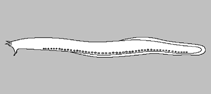
Brachial length 4.58% of total length; six pairs of gill pouches and gill apertures, gill apertures closely spaced in straight line; external opening of pharyngocutaneous duct (PCD) confluent with the most posterior left gill aperture (51 of 59 specimens examined), and much larger than other apertures; fused unicuspid teeth; eye spots present but not clear (Ref. 31545).
Body shape (shape guide): eel-like.
Copulatory organ absent. The gonads of hagfishes are situated in the peritoneal cavity. The ovary is found in the anterior portion of the gonad, and the testis is found in the posterior part. The animal becomes female if the cranial part of the gonad develops or male if the caudal part undergoes differentiation. If none develops, then the animal becomes sterile. If both anterior and posterior parts develop, then the animal becomes a functional hermaphrodite. However, hermaphroditism being characterised as functional needs to be validated by more reproduction studies (Ref. 51361 ).
Fernholm, B., 1998. Hagfish systematics. p. 33-44. In J.M. Jørgensen, J.P. Lomholt, R.E. Weber and H. Malte (eds.) The biology of hagfishes. Chapman & Hall, London. 578 p. (Ref. 31276)
Status IUCN Red List (Ref. 130435: Version 2025-2 (Global))
ancaman kepada manusia
Harmless
penggunaan manusia
Perikanan: tidak ada kepentingan
Alat, peralatan
laporan khas
muat turun XML
Sumber internet
Estimasi berdasarkan model
Indeks keanekaragaman filogenetik (Acuan
82804): PD
50 = 0.5000 [Uniqueness, from 0.5 = low to 2.0 = high].
Bayesian length-weight: a=0.00204 (0.00094 - 0.00444), b=2.92 (2.72 - 3.12), in cm total length, based on LWR estimates for this (Sub)family-body shape (Ref.
93245).
Tingkat Trofik (Acuan
69278): 4.0 ±0.7 se; based on size and trophs of closest relatives
Daya lenting (Acuan
120179): Rendah, Waktu penggandaan populasi minimum 4.5 - 14 tahun (Fec assumed to be <100).
Kerentanan Penangkapan Ikan (Ref.
59153): Low vulnerability (24 of 100).
🛈