مكسيني (hagfishes) >
Myxiniformes (Hagfishes) >
Myxinidae (Hagfishes) > Eptatretinae
Etymology: Eptatretus: hepta (Gr.), seven; tretos (Gr.), perforated (i.e., with holes), referring to seven gill apertures on what would later be described as Homea banksii (=E. cirrhatus) [range within genus is 6-14 pairs of gill apertures] (See ETYFish); nelsoni: In honor of ichthyologist Gareth J. Nelson (b. 1937), then with the American Museum of Natural History, for contributions to the promotion of phylogenetic systematics (See ETYFish).
Eponymy: Dr Gareth (Gary) Jon Nelson (d: 1937) is Emeritus Curator Vertebrate Zoology, Ichthyology, at the AMNH where he worked for over three decades (1967–1998), having been chairman of ichthyology (1982–1987) and of ichthyology and herpetology (1987–1993) [...] (Ref. 128868), visit book page.
البيئة: الوسط / المنطقة المناخية / نطاق العمق / نطاق التوزيع
البيئة
بحري القاع; غير مهاجرة; نطاق العمق 50 - 250 m (Ref. 51420). Subtropical
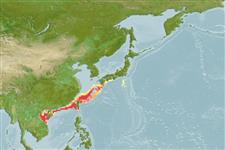
Northwest Pacific: southwest Taiwan.
الطول عند النضج الأول / الحجم / وزن / العمر
النضج: Lm 24.0, range 22 - 26 cm
Max length : 25.9 cm TL ذكر/ مختلط الجنس; (Ref. 51420)
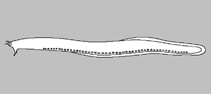
Gill apertures usually 5 (4-6). Slime pores: prebranchial 14-20; branchial 0; trunk 35-39; tail 6-10; total 57-67. Gill apertures nonlinear and crowded.
Body shape (shape guide): eel-like.
A dwarf species; males develop testes at about 20 cm and a 22.4 cm female had elongated eggs; a 26.8 cm specimen had eggs 2.4 cm long; and a 24.4 cm specimen had 11 eggs about 1.5 cm long with polar caps already forming (Ref. 51420).
دورة الحياة وسلوك التزاوج
النضج | التكاثر | وضع البيض | بيض | الخصوبة | اليرقات
Copulatory organ absent. The gonads of hagfishes are situated in the peritoneal cavity. The ovary is found in the anterior portion of the gonad, and the testis is found in the posterior part. The animal becomes female if the cranial part of the gonad develops or male if the caudal part undergoes differentiation. If none develops, then the animal becomes sterile. If both anterior and posterior parts develop, then the animal becomes a functional hermaphrodite. However, hermaphroditism being characterised as functional needs to be validated by more reproduction studies (Ref. 51361 ).
Fernholm, B., 1998. Hagfish systematics. p. 33-44. In J.M. Jørgensen, J.P. Lomholt, R.E. Weber and H. Malte (eds.) The biology of hagfishes. Chapman & Hall, London. 578 p. (Ref. 31276)
حالة القائمة الحمراء للاتحاد الدولي لحفظ الطبيعة والموارد الطبيعية (Ref. 130435: Version 2025-2 (Global))
استخدامات بشرية
مصائد: غير ذات اهمية
أدوات
تقارير خاصة
تنزيل XML
مصادر علي الأنترنت
تقديرات تستند إلى النماذج
مؤشر التنوع الشُعبي الوراثي (مرجع
82804): PD
50 = 0.5000 [Uniqueness, from 0.5 = low to 2.0 = high].
Bayesian length-weight: a=0.00204 (0.00094 - 0.00444), b=2.92 (2.72 - 3.12), in cm total length, based on LWR estimates for this (Sub)family-body shape (Ref.
93245).
مستوى غذائي (مرجع
69278): 3.9 ±0.7 se; based on size and trophs of closest relatives
المرونه (مرجع
120179): منخفض, الحد الزمني الأدني لتضاعف عدد أفراد المجتمع 4.5-14 سنة (Fec assumed to be <100).
ضعف الصيد (Ref.
59153): Low vulnerability (16 of 100).
🛈