Myxini (slijmprikken) (hagfishes) >
Myxiniformes (Hagfishes) >
Myxinidae (Hagfishes) > Myxininae
Etymology: Myxine: Ancient Greek word for a slimy fish: myxa, slime; -inus, one who, referring to copious amounts of slime produced by M. glutinosa (See ETYFish); robinsorum: -orum, commemorative suffix (L.), plural: in honor of American ichthyologists C. Richard Robins (1928-2020) and his wife Catherine, for their work on the fishes of the tropical western Atlantic (See ETYFish).
Eponymy: Dr Charles Richard ‘Dick’ Robins (1928–2020) was an American systematic ichthyologist whom one etymology honoured as an ‘eelologist’; as well as a colleague, advisor and friend, for his contributions to the knowledge of fishes (including [...] (Ref. 128868), visit book page.
Milieu: milieu / Klimaatzone / Diepte / verspreidingsgebied
Ecologie
marien bathydemersaal; standvastig; diepte 783 - 1768 m (Ref. 31276). Deep-water
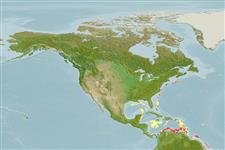
Western Central Atlantic: southern Caribbean Sea.
Grootte / Gewicht / Leeftijd
Maturiteit: Lm ? range ? - ? cm
Max length : 54.0 cm TL mannelijk / geslacht onbekend; (Ref. 31276)
Korte beschrijving
Determinatiesleutels | Morfologie | Morfometrie
Levenscyclus en paargedrag
Maturiteit | Voortplanting | Paaien | Eieren | Fecunditeit | Larven
Copulatory organ absent. The gonads of hagfishes are situated in the peritoneal cavity. The ovary is found in the anterior portion of the gonad, and the testis is found in the posterior part. The animal becomes female if the cranial part of the gonad develops or male if the caudal part undergoes differentiation. If none develops, then the animal becomes sterile. If both anterior and posterior parts develop, then the animal becomes a functional hermaphrodite. However, hermaphroditism being characterised as functional needs to be validated by more reproduction studies (Ref. 51361 ).
Fernholm, B., 1998. Hagfish systematics. p. 33-44. In J.M. Jørgensen, J.P. Lomholt, R.E. Weber and H. Malte (eds.) The biology of hagfishes. Chapman & Hall, London. 578 p. (Ref. 31276)
Status op de Rode Lijst van het IUCN (Ref. 130435: Version 2025-2 (Global))
Gevaar voor de mens
Harmless
Gebruik door de mens
Tools
Speciale rapporten
Download XML
Internetbronnen
Schattingen op basis van modellen
Fylogenetische diversiteitsindex (Ref.
82804): PD
50 = 0.5000 [Uniqueness, from 0.5 = low to 2.0 = high].
Bayesian length-weight: a=0.00115 (0.00045 - 0.00294), b=3.03 (2.81 - 3.25), in cm total length, based on LWR estimates for this (Sub)family-body shape (Ref.
93245).
Trofisch niveau (Ref.
69278): 3.4 ±0.6 se; based on size and trophs of closest relatives
Weerstandsvermogen (Ref.
120179): laag, minimale populatieverdubbelingstijd 4,5-14 jaar (Fec assumed to be <100).
Kwetsbaarheid van de visserij (Ref.
59153): Moderate vulnerability (42 of 100).
🛈