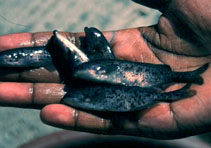
分類 / 名前
共通名の | 類義語 | Catalog of Fishes(部類, 種) | ITIS | CoL | WoRMS | Cloffa
>
Osteoglossiformes (Bony tongues) >
Mormyridae (Elephantfishes)
Etymology: Marcusenius: Becasue of J. Marcusen, author of "Zur Phauna des Schwarzen Meeres", 1867; ichthyologist.
Eponymy: Dr Johann Andreas Marcusen (1817–1894) was a Latvian of German descent who was a physician, ichthyologist and zoologist. [...] (Ref. 128868), visit book page.
More on author: Peters.
環境:環境 / 気候帯 / 深さの範囲 / 分布範囲
生態学
; 新鮮な水 底生の; pH range: 7.0 - ? ; dH range: 10 - ?; potamodromous (Ref. 51243). Tropical; 22°C - 24°C (Ref. 12468); 20°S - 31°S
Africa: Lower Zambezi River from the delta upstream to at least Tete, if not Victoria Falls, and the lower Shire River; also Pungwe, Buzi and Mulela Rivers (Ref. 75962). Also upper and central Congo basin (Ref. 3203, 95585), Lake Rukwa basin (Ref. 95585), and east flowing rivers of Tanzania and Natal (Ref. 3203). Widespread and common in the Cunene and Okavango systems (Ref. 7248). Reports from Pool Malebo (Ref. 41585), the middle Congo River (Ref. 4910) and the Lulua (Kasai drainage)(Ref. 42554) possibly refer to M. angolensis.
初回成熟時の長さ / サイズ / 重さ / 年齢
成熟: Lm 13.0 range ? - ? cm
Max length : 32.0 cm TL オス/雌雄の選別がない; (Ref. 27292); 最大公表体重: 500.00 g (Ref. 7248)
背面の脊椎 (合計) : 0; 背鰭 (合計) : 20 - 24; 肛門の骨: 0; 臀鰭: 26 - 31. Diagnosis: Marcusenius macrolepidotus is best distinguished from M. altisambesi by the number of circumpeduncular scales, which is 12-18 vs. 12-14, and an electric organ discharge lacking an initial head-negativity; from M. devosi by the number of scales in linear series along the lateral line row, which is 52-62 vs. 56-66, shorter caudal peduncle length, and weaker Namp of its electric organ discharge; from M. pongolensis by the number of scales in linear series along the lateral line row, which is 52-62 vs. 70-76, the umber of circumpeduncular scales, which is 12-18 vs. 16-20, a greater body depth, and longer Ndur of its electric organ discharge in females and juveniles; and from M. angolensis by its lower number of anal fin rays, being less than 31 vs. 33, and dorsal fin rays, being less than 24 vs. 26, and a higher number of circumpeduncular scales (Ref. 75962).
Body shape (shape guide): fusiform / normal; Cross section: compressed.
Caught with dipnets in the Kafue floodplain, Zambia. Prefers well-vegetated, muddy bottomed marginal habitats of rivers and floodplains. A shoaling species which moves inshore after dark. Migrates within rivers. Recorded to move up tributaries in shoals during flood season (Ref. 13337). Feeds on invertebrates, especially midge and mayfly larvae and pupae taken from the bottom and off plant stems. Breeds during the rainy season in shallow vegetated localities; females carry up to 6,000 eggs (Ref. 7248). Possesses electroreceptors over the entire head and on the ventral and dorsal regions of the body, but absent from the side and the caudal peduncle where the electric organ is located (Ref. 10011).
ライフサイクルと交尾行動
成熟 | 繁殖 | 放精 | 卵 | 生産力 | 幼生
Gosse, J.-P., 1984. Mormyridae. p. 63-122. In J. Daget, J.-P. Gosse and D.F.E. Thys van den Audenaerde (eds.) Check-list of the freshwater fishes of Africa (CLOFFA). ORSTOM, Paris and MRAC, Tervuren. Vol. 1. (Ref. 3203)
IUCNのレッドリストの状況は (Ref. 130435: Version 2025-2 (Global))
人間の用途
水産業: 商業; ゲームフィッシュ: はい; 水族館・水槽: 商業
用具
特記事項
XMLをダウンロードして下さい
インターネットの情報源
モデルに基づく推定値
系統多様性指数 (参照
82804): PD
50 = 0.5000 [Uniqueness, from 0.5 = low to 2.0 = high].
Bayesian length-weight: a=0.01259 (0.00753 - 0.02106), b=2.91 (2.77 - 3.05), in cm total length, based on LWR estimates for this species & Genus-body shape (Ref.
93245).
栄養段階 (参照
69278): 3.2 ±0.2 se; based on diet studies.
回復力 (参照
120179): 高い, 15か月以下の倍増期間の最小個体群 (K=0.7-1.1).
漁業の脆弱性 (Ref.
59153): Low vulnerability (22 of 100).
🛈
栄養素 (Ref.
124155): Calcium = 202 [101, 487] mg/100g; Iron = 1.82 [0.84, 3.76] mg/100g; Protein = 17.8 [15.4, 20.1] %; Omega3 = 0.562 [0.221, 1.457] g/100g; Selenium = 80.1 [29.1, 221.7] μg/100g; VitaminA = 28.3 [10.5, 77.6] μg/100g; Zinc = 1.74 [1.12, 3.45] mg/100g (wet weight);