>
Aulopiformes (Grinners) >
Synodontidae (Lizardfishes) > Synodontinae
Etymology: Synodus: Greek, syn, symphysis = grown together + Greek, odous = teeth (Ref. 45335).
More on author: Lacepède.
Ambiente: milieu / zona climatica / distribuzione batimetrica / gamma di distribuzione
Ecologia
marino associati a barriera corallina; distribuzione batimetrica 0 - 121 m (Ref. 58302), usually 5 - 60 m (Ref. 37816). Tropical; 30°N - 45°S
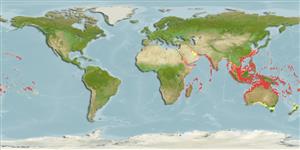
Indo-Pacific: Red Sea and East Africa to the Hawaiian, Line, Marquesan, and Ducie islands, north to the Ryukyu Islands, south to the Lord Howe, Kermadec and Rapa islands (Ref. 1602). Reported from New Zealand (Ref. 5755) and Persian Gulf (Ref. 68964).
Lunghezza alla prima maturità / Dimensione / Peso / Età
Maturità: Lm 14.0 range ? - ? cm
Max length : 40.0 cm TL maschio/sesso non determinato; (Ref. 637); common length : 30.0 cm TL maschio/sesso non determinato; (Ref. 637)
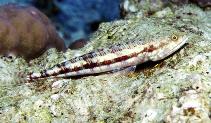
Spine dorsali (totale) : 0; Raggi dorsali molli (totale) : 10 - 14; Spine anali: 0; Raggi anali molli: 8 - 10. Adults variable from grey to red (Ref. 48635). On some individuals, the hourglass- or saddle-shaped markings along its side may be obliterated by an almost solid dark red band (Ref. 1602). Large individuals are often thick-bodied, giving a hump-backed appearance (Ref. 1602).
Body shape (shape guide): elongated; Cross section: circular.
Inhabits deep lagoon and seaward reefs to depths over 40 m (Ref. 9710); sometimes found on sandy bottoms concealing itself in the sand. Prefers to rest on hard surfaces and frequently occurs in pairs (Ref. 37816). Benthic (Ref. 58302). Feeds on small fishes by seizing these from passing schools, also shrimps (Ref. 89972). Caught with various types of artisanal gear; sold fresh or dried salted in markets. Minimum depth reported taken from Ref. 128797.
Ciclo vitale e comportamento di accoppiamento
Maturità | Riproduzione | Deposizione | Uova | Fecondità | Larve
Randall, J.E., G.R. Allen and R.C. Steene, 1990. Fishes of the Great Barrier Reef and Coral Sea. University of Hawaii Press, Honolulu, Hawaii. 506 p. (Ref. 2334)
Stato della Lista Rossa IUCN (Ref. 130435: Version 2025-2 (Global))
Minaccia per l'uomo
Harmless
Usi umani
Pesca: commerciale
Strumenti
Rapporti speciali
Scarica XML
Fonti Internet
Stime basate su modelli
Temperatura preferita (Fonte Biblio.
123201): 24.2 - 29, mean 27.8 °C (based on 2250 cells).
Indice di diversità filogenetica (Fonte Biblio.
82804): PD
50 = 0.5000 [Uniqueness, from 0.5 = low to 2.0 = high].
Bayesian length-weight: a=0.00525 (0.00417 - 0.00661), b=3.18 (3.13 - 3.23), in cm total length, based on LWR estimates for this species (Ref.
93245).
Livello trofico (Fonte Biblio.
69278): 4.2 ±0.5 se; based on diet studies.
Generation time: 2.6 ( na - na) years. Estimated as median ln(3)/K based on 1
growth studies.
Resilienza (Fonte Biblio.
120179): Alto, tempo minimo di raddoppiamento della popolazione meno di 15 mesi (K=0.4).
Vulnerabilità della pesca (Ref.
59153): Low to moderate vulnerability (30 of 100).
🛈
Nutrienti (Ref.
124155): Calcium = 43.2 [15.8, 86.0] mg/100g; Iron = 0.48 [0.17, 1.06] mg/100g; Protein = 15.9 [12.9, 18.2] %; Omega3 = 0.0636 [, ] g/100g; Selenium = 39 [16, 87] μg/100g; VitaminA = 96.6 [24.3, 306.4] μg/100g; Zinc = 0.866 [0.501, 1.302] mg/100g (wet weight);