Elasmobranchii (tubarões e raias) (sharks and rays) >
Squaliformes (Sleeper and dogfish sharks) >
Etmopteridae (Lantern sharks)
Etymology: Etmopterus: Greek, ethmos, -ou = sieve or ethmoides bone + Greek, pteron = wing, fin (Ref. 45335).
Eponymy: Dr Charles Richard ‘Dick’ Robins (1928–2020) was an American systematic ichthyologist whom one etymology honoured as an ‘eelologist’; as well as a colleague, advisor and friend, for his contributions to the knowledge of fishes (including [...] (Ref. 128868), visit book page.
Meio ambiente: milieu / Zona climática / intervalo de profundidade / faixa de distribuição
Ecologia
marinhas batidemersal; intervalo de profundidade 400 - 800 m (Ref. 55584), usually 549 - 786 m (Ref. 31236). Deep-water
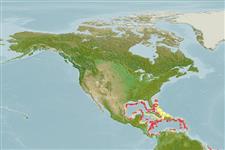
Western Central Atlantic: off northeastern Florida and the Straits of Florida (USA) south to the offings of Nicaragua, Hispaniola, and the northern Lesser Antilles. It has not been collected in the southern Caribbean Sea and only in the southernmost Gulf of Mexico.
Comprimento de primeira maturação / Tamanho / Peso / Idade
Maturidade: Lm ?, range 26 - ? cm
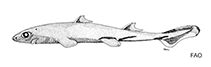
Max length : 31.0 cm TL macho/indeterminado; (Ref. 31236); 33.8 cm TL (female)
Espinhos dorsais (total) : 2. Dark-colored (Ref. 31236).
Body shape (shape guide): elongated.
Ovoviviparous (Ref. 205).
Ciclo de vida ou comportamento de acasalamento
Maturidade | Reprodução | Desova | Ovos | Fecundidade | Larvas
Distinct pairing with embrace (Ref. 205).
Schofield, P.J. and G.H. Burgess, 1997. Etmopterus robinsi (Elasmobranchii, Etmopteridae), a new Caribbean species of deepwater lantern shark from the Caribbean Sea and western north Atlantic, with a redescription of Etmopterus hillianus. Bull. Mar. Sci. 60(3):1060-1073. (Ref. 31236)
Status na Lista Vermelha da UICN (Ref. 130435: Version 2025-2 (Global))
Ameaça para os humanos
Harmless
Uso pelos humanos
Pescarias: sem interesse
Ferramentas
Relatórios especiais
Baixar XML
Fontes da internet
Estimativas baseadas em modelos
Temperatura preferida (Ref.
123201): 6 - 12.7, mean 7.8 °C (based on 72 cells).
Índice de diversidade filogenética (Ref.
82804): PD
50 = 0.5000 [Uniqueness, from 0.5 = low to 2.0 = high].
Bayesian length-weight: a=0.00389 (0.00200 - 0.00755), b=3.08 (2.91 - 3.25), in cm total length, based on LWR estimates for this Genus-body shape (Ref.
93245).
Nível Trófico (Ref.
69278): 4.1 ±0.5 se; based on size and trophs of closest relatives
Resiliência (Ref.
120179): Baixo, tempo mínimo de duplicação da população 4,5 - 14 anos (Fec assumed to be <100).
Vulnerabilidade da pesca (Ref.
59153): Low vulnerability (24 of 100).
🛈