Classification / Noms
Noms communs | Synonymes | Catalog of Fishes(Genre, Espèce) | ITIS | CoL | WoRMS | Cloffa
>
Cyprinodontiformes (Rivulines, killifishes and live bearers) >
Rivulidae (Rivulines) > Cynolebiinae
Eponymy: Julio Cezar Ghisolfi is a Brazilian biologist, aquarist and photographer living in Artur Nogueira, São Paulo. He was honoured as a ‘fervent’ breeder and collector of annual killifishes who is active in the fish-keeping world. (Ref. 128868), visit book page.
More on authors: Costa, Cyrino & Nielsen.
Environnement : milieu / zone climatique / profondeur / gamme de distribution
Écologie
; eau douce benthopélagique. Tropical
South America: São Francisco River basin, Brazil.
Taille / Poids / Âge
Maturité: Lm ? range ? - ? cm
Max length : 7.3 cm SL mâle / non sexé; (Ref. 49550)
Description synthétique
Clés d'identification | Morphologie | Morphométrie
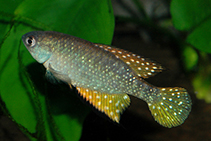
Rayons mous dorsaux (Total) : 16 - 25; Rayons mous anaux: 19 - 24; Vertèbres: 29 - 30. Caudal peduncle of female with black spots. Male's anal fin with gray to black distal stripe, yellow in color; dorsal fin anteriorly pink, posteriorly yellow; basihyal broad, 70-95% in length; vestigial contact organs on flank scales. Second pharyngobranchial teeth, 5-6. Dorsal-fin rays 20-25 in male, 16-20 in female; anal-fin rays 21-24 in male, 19-24 in female; caudal-fin rays 23, caudal fin subtruncate in male, rounded in female. Short filamentous rays on tip of dorsal and anal-fin in male, reaching vertical through middle of caudal fin (Ref. 49550).
Body shape (shape guide): short and / or deep; Cross section: compressed.
Cycle de vie et comportement reproducteur
Maturité | Reproduction | Frai | Œufs | Fécondité | Larves
Costa, W.J.E.M., 2003. Rivulidae (South American Annual Fishes). p. 526-548. In R.E. Reis, S.O. Kullander and C.J. Ferraris, Jr. (eds.) Checklist of the Freshwater Fishes of South and Central America. Porto Alegre: EDIPUCRS, Brasil. (Ref. 36579)
Statut dans la liste rouge de l'IUCN (Ref. 130435: Version 2025-2 (Global))
Menacé (EN) (B1ab(ii,iii,iv)+2ab(ii,iii,iv)); Date assessed: 18 May 2022
Menace pour l'homme
Harmless
Utilisations par l'homme
Outils
Articles particuliers
Télécharger en XML
Sources Internet
Estimations basées sur des modèles
Indice de diversité phylogénétique (Réf.
82804): PD
50 = 0.5000 [Uniqueness, from 0.5 = low to 2.0 = high].
Bayesian length-weight: a=0.01995 (0.00906 - 0.04395), b=3.01 (2.83 - 3.19), in cm total length, based on all LWR estimates for this body shape (Ref.
93245).
Niveau trophique (Réf.
69278): 3.3 ±0.4 se; based on size and trophs of closest relatives
Résilience (Réf.
120179): Haut, temps minimum de doublement de population inférieur à 15 mois (Preliminary K or Fecundity.).
Vulnérabilité de la pêche (Ref.
59153): Low vulnerability (10 of 100).
🛈