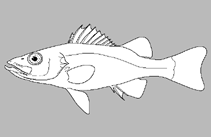
Ambiente: milieu / zona climática / intervalo de profundidade / gama de distribuição
Ecologia
; Água doce bentopelágico. Subtropical
South America: Colhue Huapi lake, Chubut, Negro, Limay and Colorado rivers, Tulumaya stream and Puente de Fierro lake in Argentina.
Tamanho / Peso / Idade
Maturidade: Lm ? range ? - ? cm
Max length : 59.1 cm TL (female)
Descrição breve
Chaves de identificação | Morfologia | Morfometria
Raios anais moles: 8 - 11. Differs from its congeners by the mouth isognathous or prognathous (vs. hypognathous); infraorbital 2 rectangular, completely serrated ventrally (vs. irregularly shaped, smooth or partially serrated ventrally); palatine with long dentigerous process (vs. short dentigerous process); dentigerous arm of premaxilla about 2.5 times height of ascending process (vs. about 2 times or less that height); small process for insertion of ligamentum primordium on maxilla; long coronoid process, reaching posteriorly the level of the posterior border of dentary (vs. not reaching posterior border of dentary); long anguloarticular bone, with well-developed, posterodorsally directed postarticular process and mandibular sensory canal completely enclosed in bone, hyoid artery in a groove on posterior surface of dorsal hypohyal ( vs. hyoid artery piercing dorsal hypohyal); dorsal border of anterior ceratohyal only smoothly concave. Differs further by the following combination of characters: quadrate-mandibular articulation just behind orbit; posterior border of maxilla reaching middle of orbit or further backwards, at posterior half of infraorbital 2 or further backwards; 3 predorsal bones; one supernumerary spine on first dorsal pterygiophore (rarely none); 3rd or 4th dorsal fin spine the longest; 7-9 trisegmented pterygiophores in dorsal fin; upper jaw length 130-160% snout length and 35-45% HL; head length 30-38% SL; pectoral and pelvic fins of similar length, being 45-60% HL and 55-75% body depth; 14-17 pectoral fin rays; 8-11 anal fin rays; 45-49 caudal fin rays; procurrent spur present (Ref. 55324).
Ciclo de vida e comportamento de acasalamento
Maturidade | Reprodução | Desova | Ovos | Fecundidade | Larvas
López-Arbarello, A., 2004. Taxonomy of the genus Percichthys (Perciformes: Percichthyidae). Ichthyol. Explor. Freshwat. 15(4):331-350. (Ref. 55324)
Categoria na Lista Vermelha da IUCN (Ref. 130435: Version 2025-2 (Global))
Ameaça para o homem
Harmless
Utilização humana
Ferramentas
Relatórios especiais
Descarregue XML
Fontes da internet
Estimativas baseadas em modelos
Índice de diversidade filogenética (Ref.
82804): PD
50 = 0.5312 [Uniqueness, from 0.5 = low to 2.0 = high].
Bayesian length-weight: a=0.00389 (0.00180 - 0.00842), b=3.12 (2.94 - 3.30), in cm total length, based on all LWR estimates for this body shape (Ref.
93245).
Nível Trófico (Ref.
69278): 4.2 ±0.2 se; based on diet studies.
Resiliência (Ref.
120179): Baixo, tempo mínimo de duplicação da população 4,5 - 14 anos (Preliminary K or Fecundity.).
Vulnerabilidade da pesca (Ref.
59153): Moderate vulnerability (44 of 100).
🛈