Ambiente: milieu / zona climática / intervalo de profundidade / gama de distribuição
Ecologia
marinhas associadas(os) a recifes; não migratória; intervalo de profundidade 3 - 300 m (Ref. 89972), usually 15 - ? m (Ref. 5222). Tropical; 30°N - 37°S, 30°E - 23°W (Ref. 5222)
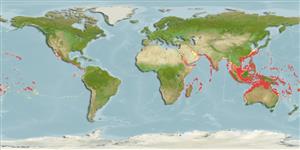
Indo-Pacific: Red Sea to South Africa and the Pitcairn Islands, north to southern Japan, south to New South Wales, Australia. Not found in the Persian Gulf nor in Hawaii.
Comprimento na primeira maturidade / Tamanho / Peso / Idade
Maturidade: Lm 47.6, range 41 - ? cm
Max length : 83.0 cm TL macho/indeterminado; (Ref. 40637); common length : 75.0 cm TL macho/indeterminado; (Ref. 5450); peso máx. Publicado: 12.0 kg (Ref. 5222)
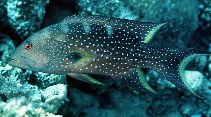
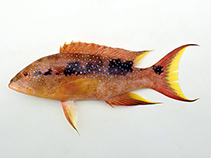
Espinhos dorsais (total) : 9; Raios dorsais moles (total) : 13 - 14; Espinhos anais: 3; Raios anais moles: 8. This species is distinguished by the following characters: body oblong, its depth less than head length and 2.8-3.3 in SL; preopercle rounded, finely serrate, the lower edge fleshy; opercle with 3 flat spines; upper edge of operculum almost straight; 1-3 large canines at midside of lower jaw; gill rakers of first gill arch 7-10 + 15-18 (including 6-87 rudiments on each limb); D IX,13-14; caudal fin lunate, the upper and lower lobes produced, about twice length of middle rays; pectoral-fin rays 16-19; lateral-line scales 66-77; lateral scale series 113-135. Colour of head, body, and median fins yellowish brown to orange-red (specimens from deep water more reddish) with numerous small round or elongate spots of blue, lavender or pink; rear margin of median fins broadly yellow; pectoral-fin rays red to brown, the distal third abruptly yellow[ large juveniles (10-25 cm SL) with irregular black band along dorsal part of body ending below rear of dorsal fin and continuing on head (up to eye) as 3 irregular black spots; black blotch at base of upper caudal-fin rays; head and body (including black band) with small pale blue to pink spots; a pale yellow or white stripe mid-dorsally on head from tip of lower jaw to dorsal-fin origin; small juveniles (< 7 cm SL) lack the black band and black spots on dorsal part of head and body (Ref. 39231, 89707, 90102).
Body shape (shape guide): fusiform / normal; Cross section: oval.
Usually seen in clear-water areas at depths below 15 m, and prefers islands and offshore reefs rather than continental shores. Feeds mainly on fishes, and on crabs, shrimps and stomatopods. It is highly appreciated for the quality of its flesh. It may not be sold in Mauritius because of cases of ciguatera poisoning (Ref. 11888). In the Hong Kong live fish markets (Ref. 27253). This common and important food fish is caught with handlines, spear, and traps (Ref. 39231).
Ciclo de vida e comportamento de acasalamento
Maturidade | Reprodução | Desova | Ovos | Fecundidade | Larvas
Heemstra, P.C. and J.E. Randall, 1993. FAO Species Catalogue. Vol. 16. Groupers of the world (family Serranidae, subfamily Epinephelinae). An annotated and illustrated catalogue of the grouper, rockcod, hind, coral grouper and lyretail species known to date. Rome: FAO. FAO Fish. Synop. 125(16):382 p. (Ref. 5222)
Categoria na Lista Vermelha da IUCN (Ref. 130435: Version 2025-2 (Global))
Ameaça para o homem
Reports of ciguatera poisoning (Ref. 4690)
Utilização humana
Pescarias: espécies comerciais; peixe desportivo: sim; Aquário: Espécies comerciais
Ferramentas
Relatórios especiais
Descarregue XML
Fontes da internet
Estimativas baseadas em modelos
Temperatura preferida (Ref.
123201): 20.1 - 28.9, mean 27.2 °C (based on 2394 cells).
Índice de diversidade filogenética (Ref.
82804): PD
50 = 0.7500 [Uniqueness, from 0.5 = low to 2.0 = high].
Bayesian length-weight: a=0.01096 (0.00998 - 0.01204), b=3.04 (3.01 - 3.07), in cm total length, based on LWR estimates for this species (Ref.
93245).
Nível Trófico (Ref.
69278): 4.3 ±0.7 se; based on diet studies.
Generation time: 6.1 ( na - na) years. Estimated as median ln(3)/K based on 2
growth studies.
Resiliência (Ref.
120179): Médio, tempo mínimo de duplicação da população 1,4 - 4,4 anos (Tmax=7-15; K=0.18).
Vulnerabilidade da pesca (Ref.
59153): Moderate vulnerability (43 of 100).
🛈
Vulnerabilidade climática (Ref.
125649): High to very high vulnerability (72 of 100).
🛈
Nutrientes (Ref.
124155): Calcium = 23.1 [14.3, 39.1] mg/100g; Iron = 0.488 [0.265, 0.792] mg/100g; Protein = 18.6 [16.8, 20.3] %; Omega3 = 0.161 [0.108, 0.250] g/100g; Selenium = 51.4 [30.8, 91.4] μg/100g; VitaminA = 106 [40, 341] μg/100g; Zinc = 0.738 [0.519, 1.037] mg/100g (wet weight);