Umwelt: Milieu / Klimazone / Tiefenbereich / Verbreitungsgebiet
Ökologie
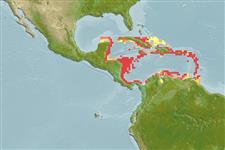
seewasser; süßwasser; brackwasser pelagic-neritic; tiefenbereich 0 - 50 m (Ref. 189). Tropical; 23°N - 7°N, 90°W - 60°W (Ref. 189)
Western Central Atlantic: Cuba and Jamaica to at least Puerto Rico, if not throughout Lesser Antilles; Yucatan (Mexico) to Colombia, Venezuela and Trinidad, but apparently not further south.
Größe / Gewicht / Alter
Geschlechtsreife: Lm ? range ? - ? cm
Max length : 9.1 cm TL Männchen/unbestimmt; (Ref. 80009); common length : 5.0 cm TL Männchen/unbestimmt; (Ref. 5217)
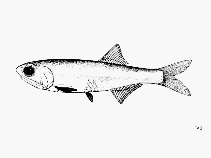
Rückenflossenstacheln (insgesamt) : 0; Afterflossenstacheln: 0; Afterflossenweichstrahlen: 17 - 22. Snout moderate, a little over 1/2 eye diameter; maxilla moderate, tip sharply pointed, reaching to or a little beyond hind border of pre-operculum; gill cover canals of walkeri-type. Anal fin fairly short, its origin before midpoint of dorsal fin base. Anus nearer to pelvic fin tips than to anal fin origin. A narrow silver stripe along flank about eye diameter (Ref. 189).
Body shape (shape guide): elongated; Cross section: oval.
A schooling species occurring in coastal waters. Enters saline lagoons, and, if identified properly, then also in freshwater (e.g. the middle and upper flights of the Gatun Locks, Canal Zone). Feeds on plankton (Ref. 5217).
Lebenszyklus und Paarungsverhalten
Geschlechtsreife | Fortpflanzung | Ablaichen | Eier | Fruchtbarkeit | Larven
Spawn in school (Ref. 205).
Whitehead, P.J.P., G.J. Nelson and T. Wongratana, 1988. FAO Species Catalogue. Vol. 7. Clupeoid fishes of the world (Suborder Clupeoidei). An annotated and illustrated catalogue of the herrings, sardines, pilchards, sprats, shads, anchovies and wolf-herrings. FAO Fish. Synop. 125(7/2):305-579. Rome: FAO. (Ref. 189)
IUCN Rote Liste Status (Ref. 130435: Version 2025-2 (Global))
Bedrohung für Menschen
Harmless
Nutzung durch Menschen
Fischereien: weniger kommerziell; Köder: usually
Tools
Zusatzinformationen
Download XML
Internet Quellen
Schätzungen auf der Grundlage von Modellen
Bevorzugte Temperatur (Ref.
123201): 26.8 - 28.3, mean 27.7 °C (based on 74 cells).
Phylogenetischer Diversitätsindex (Ref.
82804): PD
50 = 0.5000 [Uniqueness, from 0.5 = low to 2.0 = high].
Bayesian length-weight: a=0.00468 (0.00267 - 0.00819), b=3.17 (3.03 - 3.31), in cm total length, based on LWR estimates for this species & Genus-body shape (Ref.
93245).
Trophische Ebene (Ref.
69278): 3.3 ±0.4 se; based on diet studies.
Widerstandsfähigkeit (Ref.
120179): hoch, Verdopplung der Population dauert weniger als 15 Monate. (Preliminary K or Fecundity.).
Anfälligkeit der Fischerei (Ref.
59153): Low vulnerability (10 of 100).
🛈