Environnement : milieu / zone climatique / profondeur / gamme de distribution
Écologie
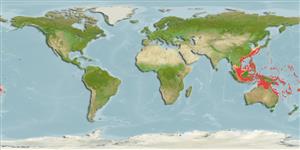
marin récifal; profondeur 2 - 150 m (Ref. 9710). Tropical; 34°N - 36°S, 99°E - 174°W (Ref. 5222)
Western Pacific: southern Japan to southern Queensland and east to Fiji and the islands of Micronesia. Recently recorded from Tonga (Ref. 53797). Record from Western Australia in the Indian Ocean is dubious. Replaced by Epinephelus flavocaeruleus in the Indian Ocean (Ref. 37816).
Longueur à la première maturité / Taille / Poids / Âge
Maturité: Lm ?, range 64 - ? cm
Max length : 122 cm TL mâle / non sexé; (Ref. 4787); poids max. publié: 17.3 kg (Ref. 40637)
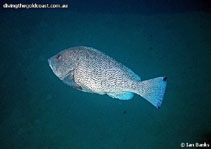
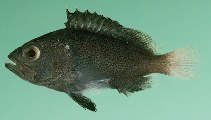
Épines dorsales (Total) : 11; Rayons mous dorsaux (Total) : 16 - 17; Épines anales: 3; Rayons mous anaux: 8. Juveniles are mostly yellow becoming gray with dark spots anteriorly. The gray area increases with increasing size until only the fins remain yellow on individuals of 15 to 20 cm (Ref. 37816).
Body shape (shape guide): fusiform / normal; Cross section: compressed.
Usually found around isolated coral heads in lagoons or bays, but also caught on outer reef area. According to Myers (1989, Ref. 4538) it usually swims out in the open, several meters above the bottom. It is readily caught by anglers at night. Feeds mainly on sand-dwelling fishes and crustaceans such as snake eels and box crabs. In Hong Kong live fish markets (Ref. 27253).
Cycle de vie et comportement reproducteur
Maturité | Reproduction | Frai | Œufs | Fécondité | Larves
Heemstra, P.C. and J.E. Randall, 1993. FAO Species Catalogue. Vol. 16. Groupers of the world (family Serranidae, subfamily Epinephelinae). An annotated and illustrated catalogue of the grouper, rockcod, hind, coral grouper and lyretail species known to date. Rome: FAO. FAO Fish. Synop. 125(16):382 p. (Ref. 5222)
Statut dans la liste rouge de l'IUCN (Ref. 130435: Version 2025-2 (Global))
Menace pour l'homme
Reports of ciguatera poisoning (Ref. 1602)
Utilisations par l'homme
Pêcheries: intérêt commercial mineur; Aquarium: Aquariums publics
Outils
Articles particuliers
Télécharger en XML
Sources Internet
Estimations basées sur des modèles
Température préférée (Réf.
123201): 22.5 - 29, mean 27.8 °C (based on 1250 cells).
Indice de diversité phylogénétique (Réf.
82804): PD
50 = 0.5000 [Uniqueness, from 0.5 = low to 2.0 = high].
Bayesian length-weight: a=0.01096 (0.00686 - 0.01753), b=3.05 (2.92 - 3.18), in cm total length, based on LWR estimates for this species & Genus-body shape (Ref.
93245).
Niveau trophique (Réf.
69278): 4.1 ±0.5 se; based on diet studies.
Résilience (Réf.
120179): Très faible, temps minimum de doublement de population supérieur à 14 ans (Preliminary K or Fecundity.).
Vulnérabilité de la pêche (Ref.
59153): High to very high vulnerability (73 of 100).
🛈
Nutriments (Ref.
124155): Calcium = 15.1 [7.2, 34.0] mg/100g; Iron = 0.448 [0.226, 0.897] mg/100g; Protein = 18.4 [16.8, 19.9] %; Omega3 = 0.112 [0.067, 0.188] g/100g; Selenium = 51 [27, 103] μg/100g; VitaminA = 192 [50, 735] μg/100g; Zinc = 0.956 [0.646, 1.371] mg/100g (wet weight);