Elasmobranquios (tiburones y rayas) (sharks and rays) >
Myliobatiformes (Stingrays) >
Urotrygonidae (American round stingrays)
Etymology: Urotrygon: Greek, oura = tail + Greek, trygon = a sting ray (Ref. 45335).
More on author: Schultz.
Entorno: milieu / zona climática / rango de profundidad / gama de distribución
Ecología
marino demersal. Tropical
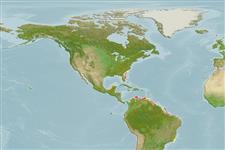
Western Central Atlantic: Gulf of Venezuela.
Longitud en la primera madurez / Tamaño / Peso / Edad
Madurez: Lm 17.6 range ? - ? cm
Max length : 29.5 cm TL macho / no sexado; (Ref. 127655); 36.2 cm TL (female)
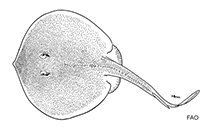
Prickly back with a median row of slightly larger spines from the nuchal region rearward along disc and anterior part of tail. Wide disc and tail long. Plain greyish above, without markings, cream colored below (Ref. 6902).
Body shape (shape guide): other.
Ciclo vital y comportamiento de apareamiento
Madurez | Reproducción | Puesta | Huevos | Fecundidad | Larva
Compagno, L.J.V., 1999. Checklist of living elasmobranchs. p. 471-498. In W.C. Hamlett (ed.) Sharks, skates, and rays: the biology of elasmobranch fishes. Johns Hopkins University Press, Maryland. (Ref. 35766)
Situación en la Lista Roja de la UICN (Ref. 130435: Version 2025-2 (Global))
Amenaza para el ser humano
Harmless
Usos humanos
Herramientas
Informes especiales
Descargar XML
Fuentes de Internet
Estimaciones basadas en modelos
Temperatura preferida (Referencia
123201): 25.4 - 28.4, mean 27 °C (based on 54 cells).
Índice de diversidad filogenética (Referencia
82804): PD
50 = 0.5001 [Uniqueness, from 0.5 = low to 2.0 = high].
Bayesian length-weight: a=0.01413 (0.00575 - 0.03468), b=3.07 (2.86 - 3.28), in cm total length, based on LWR estimates for this (Sub)family-body shape (Ref.
93245).
Nivel trófico (Referencia
69278): 3.7 ±0.6 se; based on size and trophs of closest relatives
Resiliencia (Referencia
120179): Bajo, población duplicada en un tiempo mínimo de 4.5-14 años (Assuming fecundity<100).
Vulnerabilidad pesquera (Ref.
59153): Low to moderate vulnerability (26 of 100).
🛈