Taxonomic Remarks
Validity of species questionnable (Ref. 45488).
Ambiente: milieu / zona climatica / distribuzione batimetrica / gamma di distribuzione
Ecologia
marino demersale; distribuzione batimetrica 112 - 154 m (Ref. 90860). Deep-water
Southern Ocean, Sub-Antarctic: Kerguelen Islands.
Dimensione / Peso / Età
Maturità: Lm ? range ? - ? cm
Max length : 40.2 cm TL maschio/sesso non determinato; (Ref. 90860); 36.1 cm TL (female)
Breve descrizione
Chiavi di identificazione | Morfologia | Morfometria
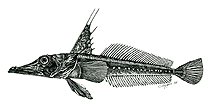
Spine dorsali (totale) : 6 - 8; Raggi dorsali molli (totale) : 32 - 34; Raggi anali molli: 29 - 32; Vertebre: 55 - 57. This species is characterized by the following: D VI-VIII,32-34 (total); A 29-32; pectoral-fin rays 20-22; vertebrae: 55-57. It is distinguished by the following characters: interorbital width wide, 4.4-5.4 times in HL, wider than horizontal orbit diameter; eyes moderate in size, orbit 5.4-6.5 times in HL, and 2.6-3.1 in snout length and 1.1-1/4 in interorbital width; posterior edge of maxilla extending below 1/2 of the orbit diameter; two rows of rakers on the lower part of 1st gill arch on ceratobranchial and hypobranchial: 11-17 rakers in anterior row, 6-15 in posterior row, 18-31 total; first dorsal fin high, 3.2-5.1 times in SL, with 1st to 3rd spine longest; fin membrane of D1 not reaching tips of longest spines; well separated dorsal fins, posterior edge of D1 fin membrane not reaching 1st ray base of D2; very developed thick rounded bony plates in anterior part of median lateral line; strong bony tuberculation on frontals, dorsal spines, branchiostegals, pelvic rays, maxilla and dentary. Coloration dark-gray to uniformly blackish. (Ref. 90860, 90861, 90862).
Body shape (shape guide): elongated.
A thalassobathyal, and planktivorous species. Stomach contents contain macroplankton, Parathemisto gaudichaudi and Thysanoessa macrura. It matures at about 30 cm TL (27 cm SL) and spawning probably takes place in June-July. Caught by bottom trawls. (Ref. 90860).
Ciclo vitale e comportamento di accoppiamento
Maturità | Riproduzione | Deposizione | Uova | Fecondità | Larve
Shandikov, G.A., 1995. A new species of icefish, Channichthys panticapaei sp. n. (Channichthyidae, Notothenioidei) from the Kerguelen Island (Antarctica). Proceedings of the Southern Scientific Research Institute of Marine Fisheries & Oceanography (YugNIRO). Kerch. Special issue (1):1-9. (Ref. 90860)
Stato della Lista Rossa IUCN (Ref. 130435: Version 2025-2 (Global))
Minaccia per l'uomo
Harmless
Usi umani
Strumenti
Rapporti speciali
Scarica XML
Fonti Internet
Stime basate su modelli
Indice di diversità filogenetica (Fonte Biblio.
82804): PD
50 = 0.5020 [Uniqueness, from 0.5 = low to 2.0 = high].
Bayesian length-weight: a=0.00129 (0.00059 - 0.00280), b=3.46 (3.28 - 3.64), in cm total length, based on LWR estimates for this (Sub)family-body shape (Ref.
93245).
Livello trofico (Fonte Biblio.
69278): 3.7 ±0.6 se; based on size and trophs of closest relatives
Resilienza (Fonte Biblio.
120179): Medio, tempo minimo di raddoppiamento della popolazione 1.4 - 4.4 anni (Preliminary K or Fecundity.).
Vulnerabilità della pesca (Ref.
59153): Low to moderate vulnerability (30 of 100).
🛈