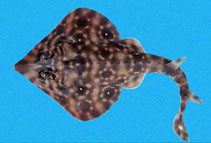
Elasmobranchii (Haie und Rochen) (sharks and rays) >
Rhinopristiformes (Shovelnose rays) >
Trygonorrhinidae (Banjo rays, Fiddler rays)
Etymology: Zapteryx: Greek, za = an augmentative particle + Greek, pteryx, wing, fin (Ref. 45335).
More on authors: Jordan & Evermann.
Umwelt: Milieu / Klimazone / Tiefenbereich / Verbreitungsgebiet
Ökologie
seewasser riff-verbunden; tiefenbereich ? - 150 m (Ref. 114953). Tropical; 24°N - 19°S, 107°W - 80°W (Ref. 114953)
Eastern Pacific: southeastern Gulf of California, Mexico to Peru (Ref. 97056). Not recorded in Compagno's 1999 checklist (Ref. 35766).
Länge bei der ersten Reifung / Größe / Gewicht / Alter
Geschlechtsreife: Lm 43.0 range ? - 45 cm
Max length : 78.0 cm TL Männchen/unbestimmt; (Ref. 114953)
Benthic species of continental shelf on rocky and sandy bottoms to depths of 150 m. It is a night feeder, mainly on small fishes and prawns (Ref. 114953). Ovoviviparous (Ref. 50449). Maturity size of males at ca. 47 cm TL, females at ca. 45 cm TL. Species born at ca. 18 cm TL. It is a likely bycatch of gillnet and prawn trawl fisheries (Ref. 114953).
Exhibit ovoviparity (aplacental viviparity), with embryos feeding initially on yolk, then receiving additional nourishment from the mother by indirect absorption of uterine fluid enriched with mucus, fat or protein through specialised structures (Ref. 50449).
Acero, A.P. and R. Franke, 1995. Nuevos registros de peces cartilaginosos del Parque Nacional Natural Gorgona (Pacífico Colombiano), II. Rayas y descripción de una nueva especie. Biblioteca Jose Jeronimo Triana (11):9-21. (Ref. 13259)
IUCN Rote Liste Status (Ref. 130435: Version 2025-2 (Global))
Bedrohung für Menschen
Harmless
Nutzung durch Menschen
Fischereien: bycatch
Tools
Zusatzinformationen
Download XML
Internet Quellen
Schätzungen auf der Grundlage von Modellen
Phylogenetischer Diversitätsindex (Ref.
82804): PD
50 = 0.6289 [Uniqueness, from 0.5 = low to 2.0 = high].
Bayesian length-weight: a=0.00724 (0.00264 - 0.01991), b=3.00 (2.77 - 3.23), in cm total length, based on LWR estimates for this (Sub)family-body shape (Ref.
93245).
Trophische Ebene (Ref.
69278): 3.6 ±0.59 se; based on food items.
Widerstandsfähigkeit (Ref.
120179): niedrig, Verdopplung der Population dauert 4,5 - 14 Jahre. (Fec assumed to be <100).
Anfälligkeit der Fischerei (Ref.
59153): Moderate to high vulnerability (51 of 100).
🛈