>
Eupercaria/misc (Various families in series Eupercaria) >
Labridae (Wrasses) > Cirrhilabrinae
Etymology: Pteragogus: Greek, pteron = wing, fin + Greek, ago = to drive (Ref. 45335).
More on author: Bleeker.
Environnement : milieu / zone climatique / profondeur / gamme de distribution
Écologie
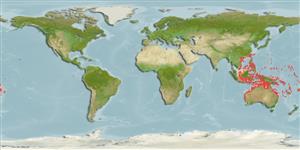
marin récifal; profondeur 2 - 64 m (Ref. 86942). Tropical; 26°N - 25°S, 108°E - 173°W
Western Pacific: Indonesia to the Coral Sea, north to Guam, south to southeastern Australia. Recently recorded from Tonga (Ref. 53797).
Taille / Poids / Âge
Maturité: Lm ? range ? - ? cm
Max length : 15.0 cm TL mâle / non sexé; (Ref. 9002)
Description synthétique
Clés d'identification | Morphologie | Morphométrie
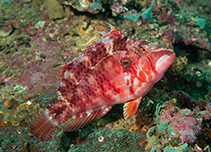
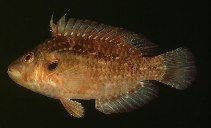
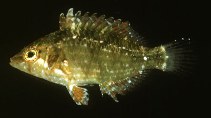
Épines dorsales (Total) : 9; Rayons mous dorsaux (Total) : 11; Épines anales: 3; Rayons mous anaux: 9. It can be distinguished from the other species by its longitudinal lines along the body (Ref. 48636). Differs from P. cryptus and P. guttatus by having IX, 11 rather than X, 9-10 dorsal rays and males with filamentous extensions on first two rather than the first four interspinous dorsal membranes (Ref. 37816).
Body shape (shape guide): fusiform / normal; Cross section: compressed.
Found in various habitats from shallow algae reefs to deep offshore on soft bottom with sponges and hydroid colonies (Ref. 9002). Mostly small, secretive species, usually hiding among dense weeds (Ref. 9002). It rarely leaves its cover except to move quickly between hydrozoan colonies, but not before having a good look around first to make sure its safe (Ref. 48636).
Cycle de vie et comportement reproducteur
Maturité | Reproduction | Frai | Œufs | Fécondité | Larves
Oviparous, distinct pairing during breeding (Ref. 205).
Kuiter, R.H., 1993. Coastal fishes of south-eastern Australia. University of Hawaii Press. Honolulu, Hawaii. 437 p. (Ref. 9002)
Statut dans la liste rouge de l'IUCN (Ref. 130435: Version 2025-2 (Global))
Menace pour l'homme
Harmless
Utilisations par l'homme
Outils
Articles particuliers
Télécharger en XML
Sources Internet
Estimations basées sur des modèles
Température préférée (Réf.
123201): 25.2 - 29.3, mean 28.4 °C (based on 1669 cells).
Indice de diversité phylogénétique (Réf.
82804): PD
50 = 0.5005 [Uniqueness, from 0.5 = low to 2.0 = high].
Bayesian length-weight: a=0.01072 (0.00427 - 0.02691), b=3.03 (2.81 - 3.25), in cm total length, based on LWR estimates for this (Sub)family-body shape (Ref.
93245).
Niveau trophique (Réf.
69278): 3.5 ±0.5 se; based on size and trophs of closest relatives
Résilience (Réf.
120179): Haut, temps minimum de doublement de population inférieur à 15 mois (Preliminary K or Fecundity.).
Vulnérabilité de la pêche (Ref.
59153): Low vulnerability (10 of 100).
🛈
Nutriments (Ref.
124155): Calcium = 82.1 [49.7, 139.3] mg/100g; Iron = 0.716 [0.423, 1.308] mg/100g; Protein = 18.4 [15.6, 20.6] %; Omega3 = 0.171 [0.110, 0.266] g/100g; Selenium = 27.4 [16.4, 48.2] μg/100g; VitaminA = 143 [44, 532] μg/100g; Zinc = 1.66 [1.14, 2.57] mg/100g (wet weight);