>
Ophidiiformes (Cusk eels) >
Carapidae (Pearlfishes) > Carapinae
Etymology: Echiodon: Greek, echieys, eos = a little viper + Greek, odous = teeth (Ref. 45335).
More on author: Rosenblatt.
Entorno: milieu / zona climática / rango de profundidad / gama de distribución
Ecología
marino demersal; rango de profundidad 64 - 75 m (Ref. 36487). Tropical
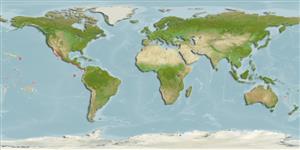
Eastern Pacific: Baja California Sur, Mexico to Panama (Ref. 36487), including the Gulf of California and the Galapagos Islands.
Tamaño / Peso / Edad
Madurez: Lm ? range ? - ? cm
Max length : 12.6 cm TL macho / no sexado; (Ref. 6347)
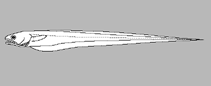
Espinas dorsales (total) : 0; Radios blandos dorsales (total) : 38 - 42; Espinas anales: 0; Radios blandos anales: 47 - 50; Vértebra: 130. Eel-like, shallow body depth; 1 to several symphyseal fangs on dentary and premaxilla; lacking cardiform teeth, pelvic fins, and swim bladder rocker bone; a patch of ridges posteriorly on the ventral surface of the swim bladder (Ref. 34024). Precaudal vertebrae 21-25 (Ref. 34024). Branchiostegal rays: 7 (Ref. 36487).
Body shape (shape guide): eel-like.
Uncommon species (Ref. 34024). Free-living adults are found on the outer shelf, usually deeper than 64 m over muddy sand bottoms (Ref. 36487). Oviparous, with specialized vexillifer planktonic larval stage, and benthic tenuis larval stage (Ref. 36487). Maximum depth from Ref. 58018.
Ciclo vital y comportamiento de apareamiento
Madurez | Reproducción | Puesta | Huevos | Fecundidad | Larva
Oviparous, with specialized vexillifer planktonic stage larva, and benthic tenuis stage larva (Ref. 36487).
Nielsen, J.G., D.M. Cohen, D.F. Markle and C.R. Robins, 1999. Ophidiiform fishes of the world (Order Ophidiiformes). An annotated and illustrated catalogue of pearlfishes, cusk-eels, brotulas and other ophidiiform fishes known to date. FAO Fish. Synop. 125(18):178p. Rome: FAO. (Ref. 34024)
Situación en la Lista Roja de la UICN (Ref. 130435: Version 2025-2 (Global))
Amenaza para el ser humano
Harmless
Usos humanos
Pesquerías: sin interés
Herramientas
Informes especiales
Descargar XML
Fuentes de Internet
Estimaciones basadas en modelos
Temperatura preferida (Referencia
123201): 14.6 - 20.3, mean 17.1 °C (based on 6 cells).
Índice de diversidad filogenética (Referencia
82804): PD
50 = 0.5001 [Uniqueness, from 0.5 = low to 2.0 = high].
Bayesian length-weight: a=0.00102 (0.00046 - 0.00225), b=3.06 (2.88 - 3.24), in cm total length, based on all LWR estimates for this body shape (Ref.
93245).
Nivel trófico (Referencia
69278): 3.5 ±0.5 se; based on size and trophs of closest relatives
Vulnerabilidad pesquera (Ref.
59153): Low vulnerability (10 of 100).
🛈