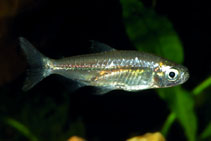
Ambiente: milieu / zona climatica / distribuzione batimetrica / gamma di distribuzione
Ecologia
; acqua dolce pelagico; pH range: 6.5 - 7.5; dH range: 10 - 25. Tropical; 23°C - 27°C (Ref. 2060)
Africa: widely distributed in the Congo basin; elsewhere, known from Lower Guinea (Cross, Ntem, and Ogowe rivers), the Niger, and Zambezi rivers and lakes Chad, Mweru, and Tanganyika (Ref. 122734); and in the Lukuga River only known downstream of Niemba (Ref. 36901, 42032). Reports from Lake Tanganyika (Ref. 80290) and Cubango/Okavango in Angola (Ref. 5331) needs confirmation (Ref. 120641).
Dimensione / Peso / Età
Maturità: Lm ? range ? - ? cm
Max length : 10.6 cm TL maschio/sesso non determinato; (Ref. 2880)
Spine dorsali (totale) : 0; Raggi dorsali molli (totale) : 10; Spine anali: 0; Raggi anali molli: 17 - 22. Diagnosis: lateral line always complete, 24-27 (Ref. 80290) or 27-30 (Ref. 81279) lateral line scales. Anal fin with 3 unbranched and 15-18 (Ref. 80290) or 14-19 (Ref. 81279) branched rays. 10-15 (Ref. 80290) or 10-14 (Ref. 81279) gill rakers on lower part of first branchial arch. 6/8 premaxillary teeth; fins colorless or, at most, pinkish; tip of dorsal fin hyaline (Ref. 2880, 81279), no black apical tip (Ref. 80290). Scales of flank with melanophores concentrated on basal margin (Ref. 80290).
Body shape (shape guide): fusiform / normal.
Affinities: M. humilis is most similar and possibly conspecific with M. stormsi Boulenger, 1902, and M. sardina Poll, 1938; apart from coloration, it is distinguished from latter two species on the basis of slight differences in overlapping features (see Ref. 80290).
Ciclo vitale e comportamento di accoppiamento
Maturità | Riproduzione | Deposizione | Uova | Fecondità | Larve
Paugy, D. and S.A. Schaefer, 2007. Alestidae. p. 347-411. In M.L.J. Stiassny, G.G. Teugels and C.D. Hopkins (eds.) Poissons d'eaux douces et saumâtres de basse Guinée, ouest de l'Afrique centrale/The fresh and brackish water fishes of Lower Guinea, west-central Africa. Vol. 1. Coll. Faune et Flore tropicales 42. Istitut de recherche pour le développement, Paris, France, Muséum nationale d'histoire naturelle, Paris, France and Musée royale de l'Afrique centrale, Tervuren, Belgique. 800 p. (Ref. 80290)
Stato della Lista Rossa IUCN (Ref. 130435: Version 2025-2 (Global))
Minaccia per l'uomo
Harmless
Usi umani
Acquario: Commerciale
Strumenti
Rapporti speciali
Scarica XML
Fonti Internet
Stime basate su modelli
Indice di diversità filogenetica (Fonte Biblio.
82804): PD
50 = 0.5000 [Uniqueness, from 0.5 = low to 2.0 = high].
Bayesian length-weight: a=0.01072 (0.00491 - 0.02339), b=3.02 (2.84 - 3.20), in cm total length, based on LWR estimates for this (Sub)family-body shape (Ref.
93245).
Livello trofico (Fonte Biblio.
69278): 3.1 ±0.4 se; based on size and trophs of closest relatives
Resilienza (Fonte Biblio.
120179): Alto, tempo minimo di raddoppiamento della popolazione meno di 15 mesi (Preliminary K or Fecundity.).
Vulnerabilità della pesca (Ref.
59153): Low vulnerability (10 of 100).
🛈