Ambiente: milieu / zona climatica / distribuzione batimetrica / gamma di distribuzione
Ecologia
; acqua dolce pelagico; pH range: 6.0 - 7.8; dH range: ? - 30; potamodromo (Ref. 51243). Tropical; 23°C - 27°C (Ref. 2060)
Africa: widely distributed in West Africa (Ref. 2880, 81279). In Lower Guinea present in Cross and Mémé rivers (Ref. 80279). Also in Chad basin (Ref. 367, 81279) and Nile River (Ref. 28714, 31439, 58460) up to Lake Albert (Ref. 4903, 42019).
Lunghezza alla prima maturità / Dimensione / Peso / Età
Maturità: Lm 8.9, range 22 - ? cm
Max length : 25.4 cm TL maschio/sesso non determinato; (Ref. 126422); peso massimo pubblicato: 200.00 g (Ref. 3799)
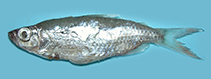
Spine anali: 0; Raggi anali molli: 13 - 18. Diagnosis: multicuspid teeth set in two rows and not overlapping the jaws when the mouth is closed; teeth stout, not compressed; eyes with well-developed vertical adipose lids; slender body; head not flattened (Ref. 28714). Dorsal fin origin at about same level as pelvic fin insertion (Ref. 2880, 80290, 81279), about halfway between caudal fin and snout (Ref. 28714). Fronto-parietal fontanel absent in adults, sometimes pore-like in juveniles, disappearing with growth; sexual dimorphism affecting anal fin shape; 24-34 lateral line scales; 5.5 scales between lateral line and dorsal fin; 10-15 anal fin branched rays; 14-20 gill rakers on lower limb of first gill arch; 8 teeth in outer premaxillary row (Ref. 2880, 80290, 81279). Snout short, more than 3x head length; head length/snout length 3.6-4.3; 10-11.5 predorsal scales; flanks without lateral band; adults medium-sized (Ref. 80290).
Body shape (shape guide): fusiform / normal.
Inhabits rivers, lakes, irrigation canals and fringing vegetation; feeds on zooplankton, Caridina, insects, snails and vegetation (Ref. 28714). Dwarf populations are described in lake basins: Lake Turkana, B. n. nana Pellegrin, 1935 and Lake Chad, B. n. dageti Blache and Miton, 1960 (see Ref. 2880).
Ciclo vitale e comportamento di accoppiamento
Maturità | Riproduzione | Deposizione | Uova | Fecondità | Larve
Paugy, D. and S.A. Schaefer, 2007. Alestidae. p. 347-411. In M.L.J. Stiassny, G.G. Teugels and C.D. Hopkins (eds.) Poissons d'eaux douces et saumâtres de basse Guinée, ouest de l'Afrique centrale/The fresh and brackish water fishes of Lower Guinea, west-central Africa. Vol. 1. Coll. Faune et Flore tropicales 42. Istitut de recherche pour le développement, Paris, France, Muséum nationale d'histoire naturelle, Paris, France and Musée royale de l'Afrique centrale, Tervuren, Belgique. 800 p. (Ref. 80290)
Stato della Lista Rossa IUCN (Ref. 130435: Version 2025-2 (Global))
Minaccia per l'uomo
Harmless
Usi umani
Pesca: scarso interesse commerciale; Acquario: Commerciale
Strumenti
Rapporti speciali
Scarica XML
Fonti Internet
Stime basate su modelli
Indice di diversità filogenetica (Fonte Biblio.
82804): PD
50 = 0.5000 [Uniqueness, from 0.5 = low to 2.0 = high].
Bayesian length-weight: a=0.01072 (0.00880 - 0.01305), b=3.01 (2.95 - 3.07), in cm total length, based on LWR estimates for this species (Ref.
93245).
Livello trofico (Fonte Biblio.
69278): 2.5 ±0.2 se; based on diet studies.
Resilienza (Fonte Biblio.
120179): Alto, tempo minimo di raddoppiamento della popolazione meno di 15 mesi (K=0.41-0.92; tm=1; Fec < 1,000).
Vulnerabilità della pesca (Ref.
59153): Low to moderate vulnerability (29 of 100).
🛈
Nutrienti (Ref.
124155): Calcium = 147 [53, 366] mg/100g; Iron = 2.12 [1.01, 4.98] mg/100g; Protein = 18.7 [16.7, 21.0] %; Omega3 = 0.503 [0.186, 1.390] g/100g; Selenium = 45 [19, 123] μg/100g; VitaminA = 42.5 [14.9, 114.6] μg/100g; Zinc = 2.38 [1.62, 3.53] mg/100g (wet weight);