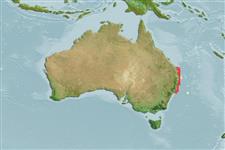
محیط زیست: محیط زیست / منطقه آب و هوایی / تغييرات عمق / محدوده توزیع
بوم شناسي
دريايي وابسته به آب سنگ; تغييرات عمق 36 - 494 m (Ref. 54394). Subtropical; 25°S - 33°S
Southwest Pacific: endemic to Australia.
اندازه / وزن / سن
بلوغ: Lm ? range ? - ? cm
Max length : 22.1 cm SL جنس نر / بدون خواص جنسي; (Ref. 54394)
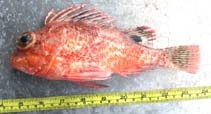
خارهاي باله پشتي (کل) : 8; شعاع نرم باله پشتي (کل) : 8; خارهاي باله مخرجي: 3; شعاع نرم باله مخرجي: 8. Diagnosis: Dorsal rays XIII, 8, third spine longest (fourth spine length sometimes equal to third). Anal rays III, 8. Pectoral rays 19-22 ( mode 20), distal margin bilobed. Pored lateral-line scales 30-33 (32); longitudinal scale series 46-54 (50); scale rows between base of last dorsal spine and lateral line 5-7 (7). Well-developed gill rakers on upper limb 1, lower limb 7 or 8 (7), total 8 or 9 (8); rudimentary gill rakers on upper limb 3-5 (4), lower limb 2-7 (4). Oval swim bladder not bilobed (length 25% of SL, width 16% of SL). Dorsal profile of snout not steep, forming angle of about 40-50° to horizontal axis of head and body. Nasal spine simple (rarely with 2 or 3 points), directed slightly forward, length of former less than or equal to (greater than in some young) anterior nostril diameter. Posterior margin of premaxilla ascending process extending beyond level of middle of posterior nostril when mouth closed. Interorbital ridge indistinct. No scales on mid interorbital space (sometimes covered with scales entirely), but scales present on supraorbital bone. Interorbital space deep, about one-fifth of orbit extending above dorsal profile of head. Preocular with a simple spine, its length slightly larger than or approximately equal to (smaller than in juveniles) that of nasal spine. Supraocular ridge with 4-10 (rarely 3) small pointed spines, not strongly canted laterally; supraocular ridge closer to orbit than interorbital ridge in dorsal view. Sphenotic with 2-15 minute pointed spines. Postorbital spine flattened and serrated. Occipital pit absent, nape flat, covered with scales. Nuchal spine with 1 or 2 points, distal margin not serrated. Pterotic spine with 1-4 points, distal margin serrated (rarely smooth), originating posterior to nuchal spine, base smaller than that of latter. Upper posttemporal spine indistinct, flattened and serrated while the lower one with 1 or 2 points. Supracleithral spine simple. Posterior margin of maxilla not reaching a vertical at posterior margin of pupil. Maxilla with scales extending posteriorly from between anterior and posterior lacrimal spines, but no scales on posterior margin. The underside of mandible smooth with 3 distinct pores on each side. Lacrimal ridge distinct with 3-7 points; anterior lacrimal spine with 1 or 2 points, directed slightly forward; posterior lacrimal spine with 2-5 points, directed ventroposteriorly; length of anterior lacrimal spine 2 times or more in that of posterior lacrimal spine. Suborbital pit flat, front rimmed by a oblique ridge on lacrimal to ventroanterior margin of orbit; scales present on entire suborbital pit; suborbital ridge with 2 pointed spines in line with lacrimal ridge, spines separated at bases, directed backward; a spine (sometimes 2-4 spines) usually arising from each suborbital spine; 2 scales usually present between ventral margin of orbit and suborbital ridge; suborbital scales not extending onto eye membrane. Preopercle with 4 spines (rarely 5 spines, fifth spine arising from above or base of uppermost preopercular spine; 2 additional small spines rarely arising between uppermost and next spines), 3 lower spines simple (rarely with 2 points), lacking a median ridge, uppermost spine with a median ridge and with a spine distally; length of uppermost preopercular spine approximately equal to pupil diameter. Upper opercular spine simple (rarely divided), lacking a median ridge; lower opercular spine simple with a median ridge; tip of lower opercular spine not extending beyond opercular margin (Ref. 54394).
Body shape (shape guide): short and / or deep.
Found in inshore reefs (Ref. 7300). Usually caught in less than 200 meters depth (Ref. 54394).
چرخه زندگی و رفتار جفتگیری
بلوغ | تولید مثل | تخم ریزی | تخم ها | باروری | توزاد ( لارو)
Motomura, H., 2003. Revision of the scorpionfish genus Neosebastes (Scorpaeniformes: Neosebastidae), with descriptions of five new species. Indo-Pac. Fish. (37):46 p. (Ref. 54394)
وضعيت در فهرست قرمز IUCN (Ref. 130435: Version 2025-2 (Global))
خطر برای انسان ها
Harmless
استفاده انسانی
ابزارها
گزارش های ويژه
بارگيری XML
منابع اينترنتي
تخمینها بر اساس مدلها
دمای ترجیحی (مرجع
123201): 19.3 - 21, mean 20 °C (based on 6 cells).
شاخص تنوع فیلوژنتیکی (مرجع
82804): PD
50 = 0.5002 [Uniqueness, from 0.5 = low to 2.0 = high].
Bayesian length-weight: a=0.01995 (0.00906 - 0.04395), b=3.01 (2.83 - 3.19), in cm total length, based on all LWR estimates for this body shape (Ref.
93245).
سطح تروفیک (مرجع
69278): 3.7 ±0.4 se; based on size and trophs of closest relatives
آسیبپذیری ماهیگیری (Ref.
59153): Low vulnerability (17 of 100).
🛈
مواد مغذی (Ref.
124155): Calcium = 36.2 [14.5, 106.0] mg/100g; Iron = 0.614 [0.280, 1.256] mg/100g; Protein = 18 [16, 20] %; Omega3 = 0.298 [0.123, 0.966] g/100g; Selenium = 23.7 [10.3, 59.7] μg/100g; VitaminA = 48.5 [11.0, 221.2] μg/100g; Zinc = 0.828 [0.515, 1.298] mg/100g (wet weight);