Ambiente: milieu / zona climatica / distribuzione batimetrica / gamma di distribuzione
Ecologia
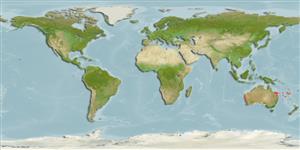
marino demersale; distribuzione batimetrica ? - 20 m (Ref. 86942). Subtropical; 20°S - 36°S
Indo-Pacific: endemic to Australia.
Dimensione / Peso / Età
Maturità: Lm ? range ? - ? cm
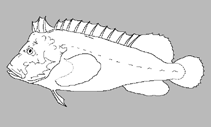
Snout with minute cirri; large patch on tip of snout across lachrymal bones about equal in size to those in smaller patch on nasal bone. Fleshy pad on isthmus with width about 1/4-1/3 of its length (Ref. 39602).
Body shape (shape guide): elongated.
Found inshore, in soft bottom.
Ciclo vitale e comportamento di accoppiamento
Maturità | Riproduzione | Deposizione | Uova | Fecondità | Larve
Paxton, J.R., D.F. Hoese, G.R. Allen and J.E. Hanley, 1989. Pisces. Petromyzontidae to Carangidae. Zoological Catalogue of Australia, Vol. 7. Australian Government Publishing Service, Canberra, 665 p. (Ref. 7300)
Stato della Lista Rossa IUCN (Ref. 130435: Version 2025-2 (Global))
Minaccia per l'uomo
Harmless
Usi umani
Strumenti
Rapporti speciali
Scarica XML
Fonti Internet
Stime basate su modelli
Temperatura preferita (Fonte Biblio.
123201): 17.8 - 25.7, mean 22.3 °C (based on 282 cells).
Indice di diversità filogenetica (Fonte Biblio.
82804): PD
50 = 0.5078 [Uniqueness, from 0.5 = low to 2.0 = high].
Bayesian length-weight: a=0.00631 (0.00252 - 0.01577), b=3.13 (2.91 - 3.35), in cm total length, based on LWR estimates for this (Sub)family-body shape (Ref.
93245).
Livello trofico (Fonte Biblio.
69278): 3.4 ±0.3 se; based on size and trophs of closest relatives
Vulnerabilità della pesca (Ref.
59153): Low vulnerability (10 of 100).
🛈