Klassifizierung / Names
Namen | Synonyme | Catalog of Fishes(Gattung, Arten) | ITIS | CoL | WoRMS | Cloffa
Umwelt: Milieu / Klimazone / Tiefenbereich / Verbreitungsgebiet
Ökologie
seewasser bathydemersal; tiefenbereich 217 - 310 m (Ref. 28982). Deep-water
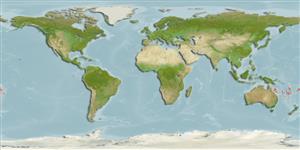
Western Pacific: Chesterfield and Bellona plateaus.
Größe / Gewicht / Alter
Geschlechtsreife: Lm ? range ? - ? cm
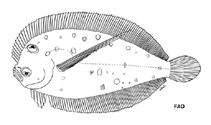
Max length : 14.0 cm SL Männchen/unbestimmt; (Ref. 28982); 13.6 cm SL (female)
Mouth large, upper-jaw length on eyed side 2.4 to 2.8 times in head length. In males, pectoral fin on eyed side greatly elongate and much longer than head (in females, not elongate and much shorter than head). Body shallow (Ref 42535).
Body shape (shape guide): short and / or deep.
Lebenszyklus und Paarungsverhalten
Geschlechtsreife | Fortpflanzung | Ablaichen | Eier | Fruchtbarkeit | Larven
Amaoka, K., E. Mihara and J. Rivaton, 1997. Pisces, Pleuronectiformes: Flatfishes from the waters around New Caledonia. Six species of the bothid genera Tosarhombus and Parabothus. p.144-171. In B. Séret (ed.) Résultats des Campagnes MUSORTOM,17, Mém. Mus. Natn. Hist. Nat. 174, 212p. (Ref. 28982)
IUCN Rote Liste Status (Ref. 130435: Version 2025-2 (Global))
Bedrohung für Menschen
Harmless
Nutzung durch Menschen
Tools
Zusatzinformationen
Download XML
Internet Quellen
Schätzungen auf der Grundlage von Modellen
Bevorzugte Temperatur (Ref.
123201): 8.9 - 18.9, mean 13.4 °C (based on 23 cells).
Phylogenetischer Diversitätsindex (Ref.
82804): PD
50 = 0.5156 [Uniqueness, from 0.5 = low to 2.0 = high].
Bayesian length-weight: a=0.00912 (0.00412 - 0.02018), b=3.05 (2.87 - 3.23), in cm total length, based on LWR estimates for this (Sub)family-body shape (Ref.
93245).
Trophische Ebene (Ref.
69278): 3.5 ±0.4 se; based on size and trophs of closest relatives
Widerstandsfähigkeit (Ref.
120179): mittel, Verdopplung der Population dauert 1,4 - 4,4 Jahre. (Assuming tmax>3).
Anfälligkeit der Fischerei (Ref.
59153): Low vulnerability (10 of 100).
🛈