>
Osteoglossiformes (Bony tongues) >
Mormyridae (Elephantfishes)
Etymology: Pollimyrus: Because of Dr. Max Poll, ichthyologist + Greek, myros, -ou = the male of the morey eel.
Eponymy: Dr Max Fernand Leon Poll (1908–1991) was a Belgian ichthyologist, and ‘connoisseur of the fish fauna’. [...] Isidore Geoffroy Saint-Hilaire (1805–1861) was a French zoologist. [...] (Ref. 128868), visit book page.
More on author: Valenciennes.
Environnement : milieu / zone climatique / profondeur / gamme de distribution
Écologie
; eau douce démersal; pH range: 6.0 - 8.0; dH range: 5 - 19; potamodrome (Ref. 51243). Tropical; 22°C - 24°C (Ref. 12468)
Africa: Senegal (Ref. 2915), Gambia, middle Niger (Ref. 3203) including the Benue (Ref. 2915), Volta and Chad basins, coastal rivers of Côte d'Ivoire (Sassandra, Bandama, Mé) and the Nile (Ref. 3203). Subspecies Pollimyrus isidori fasciaticeps and Pollimyrus isidori osborni are restricted to the Congo river basin (Ref. 3203).
Longueur à la première maturité / Taille / Poids / Âge
Maturité: Lm 6.5 range ? - ? cm
Max length : 10.3 cm TL mâle / non sexé; (Ref. 57961); poids max. publié: 7.00 g (Ref. 3799)
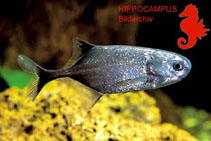
Épines dorsales (Total) : 0; Rayons mous dorsaux (Total) : 17 - 22; Épines anales: 0; Rayons mous anaux: 21 - 27. Body depth 2.8-4.2 x SL. Sokomo and Comoe forms longer with SL/Depth ratio 3-4. Head 3.8-5.0 x SL. Eye diameter 3.3-6.4 x head length. Dorsal origin slightly behind anal fin origin. Pectorals slightly shorter or equal to head length, 2-3 x longer than pelvic fins, its posterior end reaching past origin of pelvic fins. Caudal peduncle height 2.3-3.9 x of its length, 12.3-20.6 x SL. Middle reaches fish silvery in color with lots of small spots on sides and head, higher reaches fish darker with darker and fewer spots.
Body shape (shape guide): fusiform / normal; Cross section: compressed.
Occupies floodplain pools in Sudd. Feeds on mud, vegetable debris and small invertebrates (Ref. 28714). Affinities: only to P. adspersus, morphologically similar; distinguished through scales on caudal peduncle, dorsal and anal fin rays and body coloration. Generates electric organ discharge (EOD) of short duration (0.08 ms) that seems to correlate with aggregative behavior of the species (Ref. 10460; 10601). During the breeding season, males build nests and while patrolling their territory sporadically emit EODs at a mean rate of 18 Hz. Participating females, on the other hand, discharge at a fairly regular rate (8-11 Hz) and this has been shown to play a role in sex recognition during courtship and spawning. Male and female EOD waveforms also differ in the amplitude ratio of the first and third phase (Ref. 10764). Also produce natural sounds ('grunts', 'moans', 'growl', etc.) at different phases of courtship, nesting and territorial defense (Ref. 10832). A fractional spawner; females able to spawn up to 26 times in the course of one reproductive cycle, laying about 125 eggs per spawning episode. Larval electric organ situated in the deep lateral musculature; that of adults in the caudal peduncle (Ref. 10605).
Cycle de vie et comportement reproducteur
Maturité | Reproduction | Frai | Œufs | Fécondité | Larves
30-200 eggs are spawned evey 5-8 days. Male builds nest and tends eggs and larvae. Eggs hatch after 4 days and feed after 12 days.
Bigorne, R., 1990. Mormyridae. p. 122-184. In C. Lévêque, D. Paugy and G.G. Teugels (eds.) Faune des poissons d'eaux saumâtres d'Afrique de l'Ouest. tome 1. Faune Trop. 28. Musée Royal de l'Afrique Centrale, Tervuren, and ORSTOM, Paris. (Ref. 2915)
Statut dans la liste rouge de l'IUCN (Ref. 130435: Version 2025-2 (Global))
Menace pour l'homme
Harmless
Utilisations par l'homme
Pêcheries: sans intérêt; Aquarium: Commercial
Outils
Articles particuliers
Télécharger en XML
Sources Internet
Estimations basées sur des modèles
Indice de diversité phylogénétique (Réf.
82804): PD
50 = 0.5000 [Uniqueness, from 0.5 = low to 2.0 = high].
Bayesian length-weight: a=0.01175 (0.00648 - 0.02132), b=2.82 (2.66 - 2.98), in cm total length, based on LWR estimates for this species & (Sub)family-body (Ref.
93245).
Niveau trophique (Réf.
69278): 2.6 ±0.22 se; based on food items.
Résilience (Réf.
120179): Haut, temps minimum de doublement de population inférieur à 15 mois (tm=0.5).
Vulnérabilité de la pêche (Ref.
59153): Low vulnerability (10 of 100).
🛈
Nutriments (Ref.
124155): Calcium = 492 [244, 1,584] mg/100g; Iron = 3.22 [1.38, 7.00] mg/100g; Protein = 17.3 [14.8, 19.8] %; Omega3 = 0.606 [0.206, 1.757] g/100g; Selenium = 91.2 [29.7, 293.3] μg/100g; VitaminA = 26.9 [8.8, 87.6] μg/100g; Zinc = 3.37 [1.98, 7.02] mg/100g (wet weight);