Classificatie / Namen
Lokale namen | Synoniemen | Catalog of Fishes(Genus, Soort(en)) | ITIS | CoL | WoRMS | Cloffa
>
Cichliformes (Cichlids, convict blennies) >
Cichlidae (Cichlids) > Pseudocrenilabrinae
Etymology: Haplochromis: Greek, Haploos = single + Greek, chromis = a fish, perhaps a perch (Ref. 45335).
Taxonomic Remarks
This species is placed in the genus Mbipia Seehausen & Bouton, 1998 in Eschmeyer (CofF ver. Mar. 2011: Ref. 86697). We keep all the lacustrine and riverine "Haplochromine" species of the Lake Victoria catchment in the genus Haplochromis Hilgendorf, 1888 following Van Oijen et al. (1996: Ref. 12750), until a new complete taxonomic revision is published.
Milieu: milieu / Klimaatzone / Diepte / verspreidingsgebied
Ecologie
; zoet water demersaal; diepte 0 - 2 m (Ref. 27668). Tropical
Africa: known only from the western Speke Gulf and the Sengerema region of Lake Victoria, Tanzania.
Grootte / Gewicht / Leeftijd
Maturiteit: Lm ? range ? - ? cm
Max length : 13.3 cm SL mannelijk / geslacht onbekend; (Ref. 27668)
Korte beschrijving
Determinatiesleutels | Morfologie | Morfometrie
Dorsale stekels (totaal) : 15 - 16; Dorsale zachte stralen (totaal) : 9 - 10; Anale stekels: 3; Anale zachte stralen: 9 - 10; Wervels: 28 - 30.
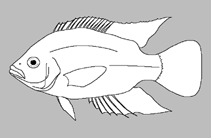
Body shape (shape guide): fusiform / normal.
Inhabits exclusively the shallow waters (0-2 m) of gently sloping small rock boulder shores, particularly surf protected habitats like small bays. Adult males keep territories at 0.5 m depth under the roots of floating reed mats, but also in large and deep pools between the rock stacks. Found over stone-sand mixed substrate. Feeds mainly on filamentous algae, but takes also insect larvae.
Levenscyclus en paargedrag
Maturiteit | Voortplanting | Paaien | Eieren | Fecunditeit | Larven
A polygynous female mouth brooder with maternal parental care. Males seem to be territorial and sometimes chase other fishes. Brooding females have been observed in very shallow water under roots of floating reed. In the aquarium, females release their fry after about 21 days but continue to keep them in the mouth in situations of danger and at night, for up to another 17 days. Size at 50% maturity not precisely known, but above 12.3 cm SL at the Makobe Island (Lake Victoria, Tanzania).
Seehausen, O., E. Lippitsch, N. Bouton and H. Zwennes, 1998. Mbipi, the rock-dwelling cichlids of Lake Victoria: description of three new genera and fifteen new species (Teleostei). Ichthyol. Explor. Freshwat. 9(2):129-228. (Ref. 27668)
Status op de Rode Lijst van het IUCN (Ref. 130435: Version 2025-2 (Global))
Gevaar voor de mens
Harmless
Gebruik door de mens
Visserij: van geen belang
Tools
Speciale rapporten
Download XML
Internetbronnen
Schattingen op basis van modellen
Fylogenetische diversiteitsindex (Ref.
82804): PD
50 = 0.5000 [Uniqueness, from 0.5 = low to 2.0 = high].
Bayesian length-weight: a=0.01445 (0.00671 - 0.03113), b=2.99 (2.82 - 3.16), in cm total length, based on LWR estimates for this (Sub)family-body shape (Ref.
93245).
Trofisch niveau (Ref.
69278): 2.6 ±0.27 se; based on food items.
Weerstandsvermogen (Ref.
120179): Hoog, minimale populatieverdubbelingstijd minder dan 15 maanden (Preliminary K or Fecundity.).
Kwetsbaarheid van de visserij (Ref.
59153): Low vulnerability (10 of 100).
🛈