Classification / Noms
Noms communs | Synonymes | Catalog of Fishes(Genre, Espèce) | ITIS | CoL | WoRMS | Cloffa
>
Cichliformes (Cichlids, convict blennies) >
Cichlidae (Cichlids) > Pseudocrenilabrinae
Etymology: Haplochromis: Greek, Haploos = single + Greek, chromis = a fish, perhaps a perch (Ref. 45335).
Environnement : milieu / zone climatique / profondeur / gamme de distribution
Écologie
; eau douce démersal; profondeur 0 - 6 m (Ref. 27668). Tropical
Africa: known from most of south-eastern Lake Victoria.
Longueur à la première maturité / Taille / Poids / Âge
Maturité: Lm 6.3 range ? - ? cm
Max length : 13.1 cm SL mâle / non sexé; (Ref. 27668)
Description synthétique
Clés d'identification | Morphologie | Morphométrie
Épines dorsales (Total) : 15 - 16; Rayons mous dorsaux (Total) : 8 - 10; Épines anales: 3; Rayons mous anaux: 7 - 9; Vertèbres: 29 - 30.
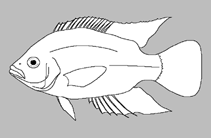
Body shape (shape guide): fusiform / normal.
Inhabits various stony and rocky habitats, including stone-sand mixed substrates. It is generally more abundant at gently sloping shores with small and medium sized rock boulders. Females, non-territorial males and subadults are gregarious and forage in groups. Feeds on a variety of food items such as diatoms, filamentous epilithic algae, detritus, insect larvae and Bryozoa.
Cycle de vie et comportement reproducteur
Maturité | Reproduction | Frai | Œufs | Fécondité | Larves
A polygynous female mouthbrooder with maternal parental care. Males defend territories of usually less than a square meter surface around a larger crevice. During courtship and male-male interactions they leave the crevice, but usually do not move far away from it. Females are led to the crevice, where the spawning takes place. Males are vigorously defending the territories against conspecific males. Brooding females guard small territories around a small cave at variable water depths. In the aquarium, females release their fry after about 21 days but continue to keep them in the mouth in situations of danger and at night, for up to another 21 days.
Seehausen, O., E. Lippitsch, N. Bouton and H. Zwennes, 1998. Mbipi, the rock-dwelling cichlids of Lake Victoria: description of three new genera and fifteen new species (Teleostei). Ichthyol. Explor. Freshwat. 9(2):129-228. (Ref. 27668)
Statut dans la liste rouge de l'IUCN (Ref. 130435: Version 2025-2 (Global))
Menace pour l'homme
Harmless
Utilisations par l'homme
Outils
Articles particuliers
Télécharger en XML
Sources Internet
Estimations basées sur des modèles
Indice de diversité phylogénétique (Réf.
82804): PD
50 = 0.5000 [Uniqueness, from 0.5 = low to 2.0 = high].
Bayesian length-weight: a=0.01445 (0.00671 - 0.03113), b=2.99 (2.82 - 3.16), in cm total length, based on LWR estimates for this (Sub)family-body shape (Ref.
93245).
Niveau trophique (Réf.
69278): 2.6 ±0.23 se; based on food items.
Résilience (Réf.
120179): Haut, temps minimum de doublement de population inférieur à 15 mois (Preliminary K or Fecundity.).
Vulnérabilité de la pêche (Ref.
59153): Low vulnerability (10 of 100).
🛈