>
Osteoglossiformes (Bony tongues) >
Mormyridae (Elephantfishes)
Etymology: Petrocephalus: Latin, petra = stone + Greek, kephale = head (Ref. 45335); sauvagii: Named in honour of Dr. H.E. Sauvage (Ref. 42539).
Eponymy: Dr Louis César Henri Ėmile Sauvage (1842–1917) was a French palaeontologist, herpetologist and ichthyologist. [...] (Ref. 128868), visit book page.
More on author: Boulenger.
البيئة: الوسط / المنطقة المناخية / نطاق العمق / نطاق التوزيع
البيئة
; المياه العذبة القاع. Tropical
Africa: Congo River basin and Niger Delta (Ref. 2915, 85331). Possibly present in the coastal Nigerian fringe (Ref. 2915). Reports from coastal basins of Cameroon (Ref. 51193) or the Chiloango (Ref. 88943) questionable as the species is reported to be absent from the Lower Guinea Ichthyological Province (Ref. 85331).
الحجم / وزن / العمر
النضج: Lm ? range ? - ? cm
Max length : 17.5 cm TL ذكر/ مختلط الجنس; (Ref. 42539)
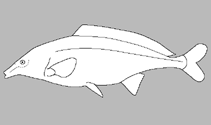
الأشواك الظهرية (المجموع) : 0; الأشعة الظهرية الناعمة (المجموع) : 26 - 28; شوكة شرجية: 0; أشعه شرجية لينه: 34 - 36. Petrocephalus sauvagii is distinguished from all other Petrocephalus species in Central Africa by the following combination of characteristics: very wide mouth (mouthwidth 2,7 to 3,7 in head length) associated with a characteristic head shape when viewed from above, anal fin with at least 32 branched rays, dorsal fin with at least 25 branched rays, mouth subterminal, ration between the head length and the mouth position as large as 7,4 (Ref. 85331). It has 17-30 teeth in upper jaw, and 29-35 teeth in lower jaw (Ref. 2915, 85331). Pigmentation pattern with two melanin markings, sometimes of weak intensity or even scarcely visible: (1) an irregularly round black mark below the anterior base (first to fourth rays) of the dorsal fin; and (2) an ovoid blackish mark, often irregularly shaped, at the base of the caudal fin, extending onto the upper and lower fleshy lobes of the fin (Ref. 85331).
Body shape (shape guide): fusiform / normal; Cross section: compressed.
Affinities: Same color as P. soudanensis, but distinguished by mouth position, number of teeth and eye size; same morphology as P. bane and P. ansorgii (Ref. 2915).
دورة الحياة وسلوك التزاوج
النضج | التكاثر | وضع البيض | بيض | الخصوبة | اليرقات
Lévêque, C.D. Paugy and G.G. Teugels (eds.), 1990. Faune des poissons d'eaux douces et saumâtres d'Afrique de l'Ouest. Tome 1. Coll. Faune Tropicale N° 28. Musée Royal de l'Afrique Centrale, Tervuren, Belgique et O.R.S.T.O.M., Paris, France. 384 p. (Ref. 2703)
حالة القائمة الحمراء للاتحاد الدولي لحفظ الطبيعة والموارد الطبيعية (Ref. 130435: Version 2025-2 (Global))
استخدامات بشرية
أدوات
تقارير خاصة
تنزيل XML
مصادر علي الأنترنت
تقديرات تستند إلى النماذج
مؤشر التنوع الشُعبي الوراثي (مرجع
82804): PD
50 = 0.5000 [Uniqueness, from 0.5 = low to 2.0 = high].
Bayesian length-weight: a=0.01549 (0.00672 - 0.03569), b=2.87 (2.69 - 3.05), in cm total length, based on LWR estimates for this Genus-body shape (Ref.
93245).
مستوى غذائي (مرجع
69278): 3.3 ±0.4 se; based on size and trophs of closest relatives
المرونه (مرجع
120179): عالي, الحد الزمني الأدني لتضاعف عدد أفراد المجتمع أقل من 15 شهر (Preliminary K or Fecundity.).
ضعف الصيد (Ref.
59153): Low vulnerability (10 of 100).
🛈