>
Characiformes (Characins) >
Acestrorhynchidae (Smallscale pike characins) > Heterocharacinae
Etymology: Heterocharax: Greek, heteros = other + Greek, charax = a marine fish without identification (Ref. 45335).
More on author: Eigenmann.
Ambiente: milieu / zona climatica / distribuzione batimetrica / gamma di distribuzione
Ecologia
; acqua dolce benthopelagico. Tropical
South America: Essequibo and Demarara River basins; Amazon River basin and tributaries between Tapajós and Tefé rivers; upper Amazon River basin and Orinoco River basin.
Dimensione / Peso / Età
Maturità: Lm ? range ? - ? cm
Max length : 4.8 cm SL maschio/sesso non determinato; (Ref. 36811)
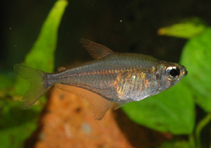
Raggi dorsali molli (totale) : 9; Vertebre: 35. Compared with H. virgulatus and H. leptogrammus, this species lacks the band of dark pigment dorsal to anal fin base (versus present); by its slightly upturned mouth with lower jaw somewhat prognathous (versus terminal mouth and more rounded snout). Distinguished further from H. virgulatus by its less pronounced longitudinal dark band running from posterior part of head to the caudal -fin base (versus a thicker and more heavily pigmented band); 4th and 5th infraorbitals represented by a single ossification (versus 2 separate elements); gill rakers on the epi-, hypo-, and cerato-branchial (anterior portion) of the first branchial arch are more developed; a small posterior dentary teeth beginning posterior to lateralmost tooth of the anterior series thus not forming a second internal teeth series; possess a more pointed posteroventral corner on the preopercle, and a relatively smaller orbital diameter and interorbital distance. Distinguished further from H. leptogrammus by having a deeper and more diamond-shaped body (versus elongate and slender); and, this species has typically higher counts for lateral -line scale and anal-fin rays (Ref. 38319).
Body shape (shape guide): fusiform / normal; Cross section: compressed.
Ciclo vitale e comportamento di accoppiamento
Maturità | Riproduzione | Deposizione | Uova | Fecondità | Larve
Toledo-Piza, M., 2000. Two new Heterocharax species (Teleostei: Ostariophysi: Characidae), with a redescription of H. macrolepis. Ichthyol. Explor. Freshwat. 11(4):289-304. (Ref. 38319)
Stato della Lista Rossa IUCN (Ref. 130435: Version 2025-2 (Global))
Minaccia per l'uomo
Harmless
Usi umani
Strumenti
Rapporti speciali
Scarica XML
Fonti Internet
Stime basate su modelli
Indice di diversità filogenetica (Fonte Biblio.
82804): PD
50 = 0.6250 [Uniqueness, from 0.5 = low to 2.0 = high].
Bayesian length-weight: a=0.01000 (0.00372 - 0.02687), b=2.97 (2.74 - 3.20), in cm total length, based on LWR estimates for this (Sub)family-body shape (Ref.
93245).
Livello trofico (Fonte Biblio.
69278): 3.5 ±0.6 se; based on size and trophs of closest relatives
Resilienza (Fonte Biblio.
120179): Alto, tempo minimo di raddoppiamento della popolazione meno di 15 mesi (Preliminary K or Fecundity.).
Vulnerabilità della pesca (Ref.
59153): Low vulnerability (10 of 100).
🛈