>
Siluriformes (Catfishes) >
Ariidae (Sea catfishes) > Ariinae
Etymology: Cathorops: Greek, kathorao = to observe, to watch + Greek, ops = appearance (Ref. 45335).
More on author: Günther.
Miljö: miljö / Klimatzon / djupintervall / distributionsområde
Ekologi
; sötvatten bentopelagisk. Tropical
Central America: Rio Motagua, Guatemala; probably in the Honduran portion of the rio Motagua near itsmouth. Reports from Mexico, Nicaragua, Costa Rica and Panama by previous authors are erroneous.
Storlek / Vikt / Ålder
Könsmognad: Lm ? range ? - ? cm
Max length : 23.0 cm TL hane/ej könsbestämd; (Ref. 58022)
Kort beskrivning
Bestämningsnycklar | Morfologi | Morfometri
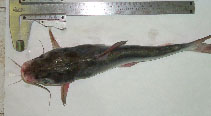
Taggstrålar i ryggfenan (totalt) : 1; Mjukstrålar i ryggfenan (totalt) : 7; Mjukstrålar i analfenan: 19 - 20. Distinguished from all other species of Cathorops by the possession of the following features: gill rakers on first arch 16-18; anal fin with 19-20 rays; snout length 5.3-5.5% SL; and posterior margin of pectoral-fin spine with prominent serrations, except in Cathorops aguadulce, Cathorops kailolae, Cathorops multiradiatus, and Cathorops tuyra. Can be further differentiated from other congeners by the following combination of characters: distance from tip of snout to dorsal-fin origin 30.0-32.6% SL; distance from tip of snout to posterior margin of dorsomedian groove of neurocranium 17.9-19.1% SL; absence of fleshy papillae intercalated with gill rakers on first two arches; head length 22.3-23.0% SL; distance between lateral cornu of lateral ethmoid and external limb of supracleithrum 19.3-19.6% SL; distance between the anterior nostrils 3.6-4.4% SL; distance between posterior nostrils 4.4-5.1% SL; orbital diameter 4.5-5.0% SL; interorbital distance 11.1-12.1% SL; mouth width 8.9-9.7% SL; premaxilla width 5.1-5.8% SL; intense black pigmentation on pelvic fin; distance from tip of snout to pelvic-fin origin 46.2-49.1% SL; dorsal-fin spine length 17.2-18.1% SL; caudal-peduncle height 8.7-9.0% SL; width of cephalic shield at supracleithrum area 16.7-16.9% SL; and body width 19.6-20.1% SL (Ref. 75004).
Body shape (shape guide): fusiform / normal.
Livscykel och parningsbeteende
Könsmognad | Reproduktion | Lek | Ägg | Fekunditet | Larver
Marceniuk, A.P. and C.J. Ferraris Jr., 2003. Ariidae (Sea catfishes). p. 447-455. In R.E. Reis, S.O. Kullander and C.J. Ferraris, Jr. (eds.) Checklist of the freshwater fishes of South and Central America. Porto Alegre: EDIPUCRS, Brasil. (Ref. 39852)
Status på IUCN:s rödlista (Ref. 130435: Version 2025-2 (Global))
Hot mot människor
Traumatogenic (Ref. 58010)
Mänskliga användningsområden
Fiskeri: kommersiell
Verktyg
Särskilda rapporter
Ladda ner XML
Internet-källor
Uppskattningar baserade på modeller
Index för fylogenetisk mångfald (Ref.
82804): PD
50 = 0.5000 [Uniqueness, from 0.5 = low to 2.0 = high].
Bayesian length-weight: a=0.00832 (0.00516 - 0.01342), b=3.11 (2.97 - 3.25), in cm total length, based on LWR estimates for this species & Genus-body shape (Ref.
93245).
Trofisk nivå (Ref.
69278): 4.2 ±0.8 se; based on size and trophs of closest relatives
Resiliens (Ref.
120179): Hög, lägsta populationsfördubblingstid mindre än 15 månader (Preliminary K or Fecundity.).
Sårbarhet i fisket (Ref.
59153): Low vulnerability (13 of 100).
🛈