>
Blenniiformes (Blennies) >
Tripterygiidae (Triplefin blennies) > Tripterygiinae
Etymology: Enneapterygius: Greek, ennea = nine times + Greek, pterygion = little fin (Ref. 45335); fuscoventer: Specific name refers to the dark ventral side of the male.
More on author: Fricke.
Umwelt: Milieu / Klimazone / Tiefenbereich / Verbreitungsgebiet
Ökologie
seewasser riff-verbunden; tiefenbereich 0 - 5 m (Ref. 58018). Tropical
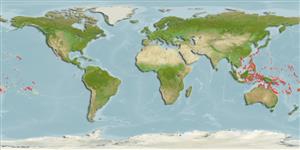
Western Pacific: Taiwan, Philippines, Papua New Guinea, Fiji, American Samoa, and Society Islands (French Polynesia).
Größe / Gewicht / Alter
Geschlechtsreife: Lm ? range ? - ? cm
Max length : 2.3 cm SL Männchen/unbestimmt; (Ref. 27223)
Kurzbeschreibung
Bestimmungsschlüssel | Morphologie | Morphometrie
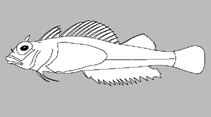
Rückenflossenstacheln (insgesamt) : 14 - 17; Rückenflossenweichstrahlen (insgesamt) : 8 - 10; Afterflossenstacheln: 1; Afterflossenweichstrahlen: 16 - 19. Brown to reddish with yellowish patch on top of head, triangular black markings along belly, and blackish anal and caudal fins (central portion and margin of caudal fin lighter). Male with black "mask" covering front and lower two-thirds of head. Dorsal rays III + XI-XIV + 8-10; anal rays I,16-19; pectoral rays 16-17; pelvic rays I,2; lateral line interrupted, 15-19 + 14-19; head, chest, and pectoral-fin base scaleless; short orbital tentacle present; mandibular pores 3-5 + 1 + 3-5. Maximum size to 2.8 cm TL (Ref. 90102).
Body shape (shape guide): elongated; Cross section: oval.
Adults are found in rock and coral reefs 5 m or shallower (Ref. 90102). Eggs are hemispherical and covered with numerous sticky threads that anchor them in the algae on the nesting sites (Ref. 240). Larvae are planktonic which occur primarily in shallow, nearshore waters (Ref. 94114).
Lebenszyklus und Paarungsverhalten
Geschlechtsreife | Fortpflanzung | Ablaichen | Eier | Fruchtbarkeit | Larven
Fricke, R., 1997. Tripterygiid fishes of the western and central Pacific, with descriptions of 15 new species, including an annotated checklist of world Tripterygiidae (Teleostei). Theses Zool. 29:1-607. (Ref. 27223)
IUCN Rote Liste Status (Ref. 130435: Version 2025-2 (Global))
Bedrohung für Menschen
Harmless
Nutzung durch Menschen
Fischereien: nicht kommerziell
Tools
Zusatzinformationen
Download XML
Internet Quellen
Schätzungen auf der Grundlage von Modellen
Bevorzugte Temperatur (Ref.
123201): 26.4 - 29.3, mean 28.6 °C (based on 1410 cells).
Phylogenetischer Diversitätsindex (Ref.
82804): PD
50 = 0.5000 [Uniqueness, from 0.5 = low to 2.0 = high].
Bayesian length-weight: a=0.00617 (0.00290 - 0.01310), b=3.04 (2.86 - 3.22), in cm total length, based on LWR estimates for this (Sub)family-body shape (Ref.
93245).
Trophische Ebene (Ref.
69278): 3.1 ±0.3 se; based on size and trophs of closest relatives
Widerstandsfähigkeit (Ref.
120179): hoch, Verdopplung der Population dauert weniger als 15 Monate. (Preliminary K or Fecundity.).
Anfälligkeit der Fischerei (Ref.
59153): Low vulnerability (10 of 100).
🛈