>
Blenniiformes (Blennies) >
Tripterygiidae (Triplefin blennies) > Tripterygiinae
Etymology: Enneapterygius: Greek, ennea = nine times + Greek, pterygion = little fin (Ref. 45335).
More on author: Fricke.
Milieu: milieu / Klimaatzone / Diepte / verspreidingsgebied
Ecologie
marien rifbewoner; diepte 0 - 18 m (Ref. 27223). Tropical
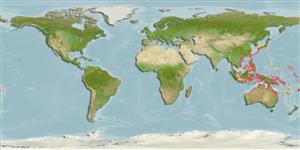
Western Pacific: Japan, Taiwan, Philippines, Indonesia, Papua New Guinea, Australia, Palau, and Guam.
Grootte / Gewicht / Leeftijd
Maturiteit: Lm ? range ? - ? cm
Max length : 4.0 cm TL mannelijk / geslacht onbekend; (Ref. 90102)
Korte beschrijving
Determinatiesleutels | Morfologie | Morfometrie
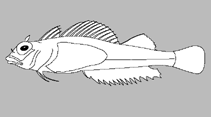
Dorsale stekels (totaal) : 14 - 18; Dorsale zachte stralen (totaal) : 6 - 11; Anale stekels: 1; Anale zachte stralen: 16 - 20. Male with reddish head and body, row of white blotches along side, additional row of white saddles on back, blackish tail, and black "mask" on front and lower half of head. Female translucent yellowish or orange with faint dark saddles/streaks on back. Dorsal rays III + XI-XV + 6-11; anal rays I,16-20; pectoral rays 16-18; pelvic rays I,2; lateral line interrupted, 13-20 + 13-22; head, chest, and pectoral-fin base scaleless; simple orbital tentacle present; mandibular pores 3-6 + 2-8 + 3-6. Maximum size to 4 cm TL (Ref. 90102).
Body shape (shape guide): elongated.
Adults occur in shallow waters, mainly on the reef flat or crest. They are found on shady vertical rock walls with some current and relatively high oxygen level (Ref. 27223). Eggs are hemispherical and covered with numerous sticky threads that anchor them in the algae on the nesting sites (Ref. 240). Larvae are planktonic which occur primarily in shallow, nearshore waters (Ref. 94114).
Levenscyclus en paargedrag
Maturiteit | Voortplanting | Paaien | Eieren | Fecunditeit | Larven
Fricke, R., 1997. Tripterygiid fishes of the western and central Pacific, with descriptions of 15 new species, including an annotated checklist of world Tripterygiidae (Teleostei). Theses Zool. 29:1-607. (Ref. 27223)
Status op de Rode Lijst van het IUCN (Ref. 130435: Version 2025-2 (Global))
Gevaar voor de mens
Harmless
Gebruik door de mens
Visserij: van geen belang
Tools
Speciale rapporten
Download XML
Internetbronnen
Schattingen op basis van modellen
Gewenste temperatuur (Ref.
123201): 24.7 - 29.3, mean 28.5 °C (based on 1586 cells).
Fylogenetische diversiteitsindex (Ref.
82804): PD
50 = 0.5000 [Uniqueness, from 0.5 = low to 2.0 = high].
Bayesian length-weight: a=0.00617 (0.00290 - 0.01310), b=3.04 (2.86 - 3.22), in cm total length, based on LWR estimates for this (Sub)family-body shape (Ref.
93245).
Trofisch niveau (Ref.
69278): 3.1 ±0.3 se; based on size and trophs of closest relatives
Weerstandsvermogen (Ref.
120179): Hoog, minimale populatieverdubbelingstijd minder dan 15 maanden (Preliminary K or Fecundity.).
Kwetsbaarheid van de visserij (Ref.
59153): Low vulnerability (10 of 100).
🛈