>
Acropomatiformes (Oceanic basses) >
Hemerocoetidae (Indo-Pacific duckbills)
Etymology: Enigmapercis: Latin, aenigma = to speak allusively or obscurely + Greek, perke = perch (Ref. 45335).
More on author: Whitley.
Ambiente: milieu / zona climatica / distribuzione batimetrica / gamma di distribuzione
Ecologia
marino demersale; distribuzione batimetrica 1 - 130 m (Ref. 9002). Subtropical
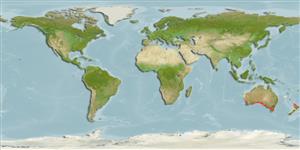
Indo-Pacific: South Australia to central New South Wales, Australia, including Bass Strait.
Dimensione / Peso / Età
Maturità: Lm ? range ? - ? cm
Max length : 9.0 cm TL maschio/sesso non determinato; (Ref. 9002)
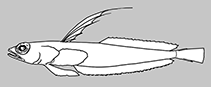
Spine dorsali (totale) : 0; Raggi dorsali molli (totale) : 29; Spine anali: 0; Raggi anali molli: 24. Pale in color, matching type of sand in which they bury (Ref. 9002). Anterior nostril with 2 projections (Ref 12932).
Body shape (shape guide): elongated.
Usually buried in the upper parts of wave-formed sand in clear sand estuaries and coastal bays (Ref. 9002). Occurs in shallow waters and to at least 130 m (Ref. 9002).
Ciclo vitale e comportamento di accoppiamento
Maturità | Riproduzione | Deposizione | Uova | Fecondità | Larve
Kuiter, R.H., 1993. Coastal fishes of south-eastern Australia. University of Hawaii Press. Honolulu, Hawaii. 437 p. (Ref. 9002)
Stato della Lista Rossa IUCN (Ref. 130435: Version 2025-2 (Global))
Minaccia per l'uomo
Harmless
Usi umani
Strumenti
Rapporti speciali
Scarica XML
Fonti Internet
Stime basate su modelli
Temperatura preferita (Fonte Biblio.
123201): 14.9 - 22.3, mean 17.5 °C (based on 332 cells).
Indice di diversità filogenetica (Fonte Biblio.
82804): PD
50 = 0.7500 [Uniqueness, from 0.5 = low to 2.0 = high].
Bayesian length-weight: a=0.00389 (0.00180 - 0.00842), b=3.12 (2.94 - 3.30), in cm total length, based on all LWR estimates for this body shape (Ref.
93245).
Livello trofico (Fonte Biblio.
69278): 3.3 ±0.4 se; based on size and trophs of closest relatives
Resilienza (Fonte Biblio.
120179): Alto, tempo minimo di raddoppiamento della popolazione meno di 15 mesi (Preliminary K or Fecundity.).
Vulnerabilità della pesca (Ref.
59153): Low vulnerability (10 of 100).
🛈