>
Gonorynchiformes (Milkfishes) >
Kneriidae (Shellears)
Etymology: Kneria: From Kner, that studied fishes in the Imperial Museum of Vienna, with Jean Natterer (1817) (Ref. 45335); rukwaensis: Refers to the Lake Rukwa basin, Tanzania and Zambia, where the center of distribution of the species is situated; an adjective (Ref. 26644).
Eponymy: Dr Rudolf Kner (1810–1869) was an Austrian zoologist specialising in ichthyology. [...] (Ref. 128868), visit book page.
Ambiente: milieu / zona climatica / distribuzione batimetrica / gamma di distribuzione
Ecologia
; acqua dolce demersale. Tropical; ? - 20°C (Ref. 27292)
Africa: restricted to the western drainage of the Lake Rukwa system and to the upper Kalambo drainage (Tanganyika basin) in Tanzania and Zambia (Ref. 26644).
Dimensione / Peso / Età
Maturità: Lm ? range ? - ? cm
Max length : 6.2 cm SL maschio/sesso non determinato; (Ref. 26644)
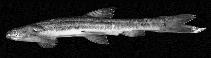
Spine dorsali (totale) : 0; Raggi dorsali molli (totale) : 8 - 11; Spine anali: 0; Raggi anali molli: 9 - 11. Diagnosis: dorsal fin origin behind pelvic fin origin; 96-104 lateral line scales; preanal length 70.7-76.2% SL; prepelvic length 46.7-52.6% SL; 9-11 anal fin rays (Ref. 26644). Lower lobe of caudal fin longer and narrower than upper lobe in fully adult males (Ref. 26644, 27292), the upper lobe as long as the proximal part of the caudal fin (Ref. 27292). Opercular disc of males characteristic, its posterior margin broad, and postopercular apparatus well developed and pillow-like (Ref. 26644).
Body shape (shape guide): elongated; Cross section: circular.
Maximum total length recorded is 7.44cm TL (Ref. 26644). Mostly found in stagnant pools and moderately flowing streams, only rarely in fast flowing currents; omnivorous; a female of 6.55cm TL releases about 400-500 ripe eggs of a diameter of 1.2mm (Ref. 27292). Apparently no marked spawning period (Ref. 44637). Male reported to change its coloration at night, being very pale with dark spots along the midline of the body (Ref. 27292).
Ciclo vitale e comportamento di accoppiamento
Maturità | Riproduzione | Deposizione | Uova | Fecondità | Larve
Seegers, L., 1995. Revision of the Kneriidae of Tanzania with description of three new Kneria species (Teleostei: Gonorhynchifromes). Ichthyol. Explor. Freshwat. 6(2):97-128. (Ref. 26644)
Stato della Lista Rossa IUCN (Ref. 130435: Version 2025-2 (Global))
Minaccia per l'uomo
Harmless
Usi umani
Strumenti
Rapporti speciali
Scarica XML
Fonti Internet
Stime basate su modelli
Indice di diversità filogenetica (Fonte Biblio.
82804): PD
50 = 0.5000 [Uniqueness, from 0.5 = low to 2.0 = high].
Bayesian length-weight: a=0.00389 (0.00180 - 0.00842), b=3.12 (2.94 - 3.30), in cm total length, based on all LWR estimates for this body shape (Ref.
93245).
Vulnerabilità della pesca (Ref.
59153): Low vulnerability (10 of 100).
🛈