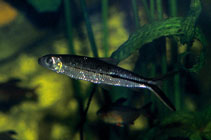
>
Characiformes (Characins) >
Hemiodontidae (Halftooths)
Etymology: Hemiodus: Greek, hemi = half + Greek, odous = teeth (Ref. 45335).
Eponymy: Dr Carl Ternetz (1870–1928) was a Swiss-born ichthyologist and naturalist who first collected near Basel (1892) and subsequently collected in South America over a period of more than thirty years (from c. [...] (Ref. 128868), visit book page.
More on author: Myers.
Taxonomic Remarks
See Langeani (1999: 719 and Tab. 1) for some diagnostic characters and comparison with other species.
Ambiente: milieu / zona climática / intervalo de profundidade / gama de distribuição
Ecologia
; Água doce bentopelágico. Subtropical
South America: Tocantins River basin in Brazil.
Tamanho / Peso / Idade
Maturidade: Lm ? range ? - ? cm
Max length : 21.5 cm SL macho/indeterminado; (Ref. 125983); 25.2 cm (female); peso máx. Publicado: 244.94 g (Ref. 125983); peso máx. Publicado: 244.94 g
Descrição breve
Chaves de identificação | Morfologia | Morfometria
Dorsal fin plain, with no blotches; longitudinal stripe starting point behind the eye.
Body shape (shape guide): elongated.
Iteroparous synchronous spawner (Ref. 51777).
Ciclo de vida e comportamento de acasalamento
Maturidade | Reprodução | Desova | Ovos | Fecundidade | Larvas
Distinct pairing (Ref. 205).
Langeani, F., 1999. New species of Hemiodus (Ostariophysi, Characiformes, Hemiodontidae) from the Rio Tocantins, Brazil, with comments on color patterns and tooth shapes within the species and genus. Copeia 1999(3):718-722. (Ref. 31397)
Categoria na Lista Vermelha da IUCN (Ref. 130435: Version 2025-2 (Global))
Ameaça para o homem
Harmless
Utilização humana
Ferramentas
Relatórios especiais
Descarregue XML
Fontes da internet
Estimativas baseadas em modelos
Índice de diversidade filogenética (Ref.
82804): PD
50 = 0.5000 [Uniqueness, from 0.5 = low to 2.0 = high].
Bayesian length-weight: a=0.00912 (0.00578 - 0.01439), b=3.20 (3.06 - 3.34), in cm total length, based on LWR estimates for this species & (Sub)family-body (Ref.
93245).
Nível Trófico (Ref.
69278): 2.7 ±0.3 se; based on size and trophs of closest relatives
Vulnerabilidade da pesca (Ref.
59153): Low vulnerability (12 of 100).
🛈