Klassifizierung / Names
Namen | Synonyme | Catalog of Fishes(Gattung, Arten) | ITIS | CoL | WoRMS | Cloffa
>
Characiformes (Characins) >
Lebiasinidae (Pencilfishes) > Pyrrhulininae
Eponymy: Edward Drinker Cope (1840–1897) was an American palaeontologist, anatomist, herpetologist and ichthyologist. [...] (Ref. 128868), visit book page.
More on author: Myers.
Taxonomic Remarks
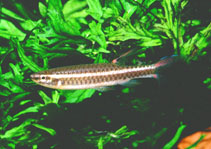
Myers did not originally illustrate this fish but Géry (1977:147) published a drawing by Pablo Bravo prepared under Myers’ direction, probably from the holotype. Until rather recently it was not known except for the preserved types. It occurs in acid clear and black water streams and is collected with the green neon, Paracheirodon simulans, and imported with it at times. It is a very slender fish, and the dorsal fin is placed far back on the body, almost over the anal fin. In life it grows to 6 cm or more. Its breeding behavior has not been noted. Marilyn Weitzman, pers. comm., Eschmeyer, 1998:402.
Umwelt: Milieu / Klimazone / Tiefenbereich / Verbreitungsgebiet
Ökologie
; süßwasser benthopelagisch. Subtropical
South America: Upper rio Negro upstream from São Gabriel da Cachoeira, Brazil and Venezuela.
Größe / Gewicht / Alter
Geschlechtsreife: Lm ? range ? - ? cm
Max length : 6.9 cm SL Männchen/unbestimmt; (Ref. 137764); 4.8 cm SL (female)
Kurzbeschreibung
Bestimmungsschlüssel | Morphologie | Morphometrie
Rückenflossenweichstrahlen (insgesamt) : 8; Afterflossenweichstrahlen: 9; Wirbelzahl: 36 - 37. This species is distinguished from all its congeners, except C. vilmae, by having 16±18 scales in the first longitudinal scale row (vs. 13±15), and by having 26±27 scales in the fourth longitudinal scale row (vs. 23±25); the males can be distinguished from that of C. vilmae by the absence of rows of conspicuous dark scales irregularly arranged on body (vs. presence); while females differs from the those of C. vilmae by the absence of a dark longitudinal band on body (vs. presence). Among Copella species, this is the largest species of the genus, with males reaching 6.89 cm SL and the females 4.81 cm SL (vs. less than 5.55 cm SL and 4.42cmm SL, respectively, in the congeners) (Ref. 137764).
Body shape (shape guide): elongated; Cross section: compressed.
Lebenszyklus und Paarungsverhalten
Geschlechtsreife | Fortpflanzung | Ablaichen | Eier | Fruchtbarkeit | Larven
Marinho, M.M.F. and N.A. Menezes, 2017. Taxonomic review of Copella (Characiformes: Lebiasinidae) with an identification key for the species. PLoS ONE 12(8):e0183069:1-53. (Ref. 137764)
IUCN Rote Liste Status (Ref. 130435: Version 2025-2 (Global))
Bedrohung für Menschen
Harmless
Nutzung durch Menschen
Tools
Zusatzinformationen
Download XML
Internet Quellen
Schätzungen auf der Grundlage von Modellen
Phylogenetischer Diversitätsindex (Ref.
82804): PD
50 = 0.5156 [Uniqueness, from 0.5 = low to 2.0 = high].
Bayesian length-weight: a=0.00646 (0.00280 - 0.01488), b=3.13 (2.93 - 3.33), in cm total length, based on LWR estimates for this (Sub)family-body shape (Ref.
93245).
Trophische Ebene (Ref.
69278): 3.4 ±0.4 se; based on size and trophs of closest relatives
Anfälligkeit der Fischerei (Ref.
59153): Low vulnerability (10 of 100).
🛈