Elasmobranchii (hajar och rockor) (sharks and rays) >
Torpediniformes (Electric rays) >
Torpedinidae (Electric rays)
Etymology: Torpedo: Latin, torpere = be sluggish (Ref. 45335).
More on author: Risso.
Miljö: miljö / Klimatzon / djupintervall / distributionsområde
Ekologi
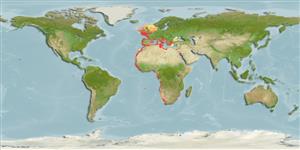
marina; brackvatten revassocierade; djupintervall 2 - 370 m (Ref. 4430). Subtropical; ? - 20°C (Ref. 10011); 60°N - 34°S, 19°W - 36°E (Ref. 114953)
Eastern Atlantic: northern UK (less common in southern North Sea and Kattegat) to Cape of Good Hope, South Africa; including the Mediterranean Sea.
Längd vid första mognad / Storlek / Vikt / Ålder
Könsmognad: Lm 44.0, range 39 - 49 cm
Max length : 100.0 cm TL hane/ej könsbestämd; (Ref. 27000); common length : 60.0 cm TL hane/ej könsbestämd; (Ref. 114953); publicerad maxvikt: 3.0 kg (Ref. 35388)
Kort beskrivning
Bestämningsnycklar | Morfologi | Morfometri
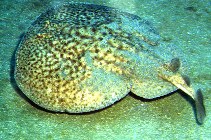
Taggstrålar i ryggfenan (totalt) : 0; Taggstrålar i analfenan: 0; Ryggkotor: 104 - 108. Disc-width around the same as its length, length and width 1,50 to 1,70 times in total length; dorsal fins more or less rounded, its base 1,50 times in its height (Ref. 39215).
Body shape (shape guide): other; Cross section: flattened.
Occurs in seagrass areas, rocky reefs, and adjacent soft bottoms (Ref. 12951). Avoids temperatures above 20°C (Ref. 10011). Nocturnal, usually burying itself during the day with only the eyes and spiracle jutting out (Ref. 12382). Feeds on small benthic fishes Trachurus, Mugil, Mullus, Dicentrarchus, Spondyliosoma, Boops, Labrus, Dascyllus, Pomacentrus) and crustaceans (Ref. 10011). Females outlive males; viviparous, neonates measuring 10-14 cm at birth (Ref. 10426). Produces 2-32 pups in a litter after a 10-month gestation (Ref. 12951, Ref. 114953). Males reaches maturity at ca. 30 cm TL, females at ca. 40 cm TL; born at 10-14 cm TL (Ref. 114953). Electrocytes start developing when the embryo weighs about 1 g; electric organs functional before birth and newborns can use their electric organ discharge (EOD) in capturing prey (Ref. 10428). Can produce electric discharges of up to 200 volts; EOD frequency up to 600 Hz. Jumps on fast-moving prey, paralyzing it with its EOD (Ref. 27000).
Exhibit ovoviparity (aplacental viviparity), with embryos feeding initially on yolk, then receiving additional nourishment from the mother by indirect absorption of uterine fluid enriched with mucus, fat or protein through specialised structures (Ref. 50449).
Stehmann, M. and D.L. Bürkel, 1984. Torpedinidae. p. 159-162. In P.J.P. Whitehead, M.-L. Bauchot, J.-C. Hureau, J. Nielsen and E. Tortonese (eds.) Fishes of the north-eastern Atlantic and Mediterranean. UNESCO, Paris. Vol. 1. (Ref. 2803)
Status på IUCN:s rödlista (Ref. 130435: Version 2025-2 (Global))
Mänskliga användningsområden
Fiskeri: saknar intresse; sportfisk: ja; Akvarium: Offentliga akvarier
Verktyg
Särskilda rapporter
Ladda ner XML
Internet-källor
Uppskattningar baserade på modeller
Önskad temperatur (Ref.
123201): 10.1 - 19.2, mean 14.1 °C (based on 392 cells).
Index för fylogenetisk mångfald (Ref.
82804): PD
50 = 0.5005 [Uniqueness, from 0.5 = low to 2.0 = high].
Bayesian length-weight: a=0.01778 (0.01477 - 0.02141), b=2.94 (2.88 - 3.00), in cm total length, based on LWR estimates for this species (Ref.
93245).
Trofisk nivå (Ref.
69278): 4.5 ±0.0 se; based on diet studies.
Resiliens (Ref.
120179): Låg, lägsta populationsfördubblingstid 4,5-14 år (Fec=5-32).
Sårbarhet i fisket (Ref.
59153): High vulnerability (60 of 100).
🛈
Näringsämnen (Ref.
124155): Calcium = 5.92 [0.80, 27.36] mg/100g; Iron = 0.378 [0.092, 1.074] mg/100g; Protein = 19.4 [14.9, 22.8] %; Omega3 = 0.27 [0.11, 0.65] g/100g; Selenium = 14.8 [4.2, 42.9] μg/100g; VitaminA = 63.8 [17.2, 235.5] μg/100g; Zinc = 0.555 [0.260, 1.159] mg/100g (wet weight);