分类 / 名称
俗名 | 同种异名 | Catalog of Fishes(属, 种) | ITIS | CoL | WoRMS | Cloffa
Teleostei >
Stomiiformes (Lightfishes and dragonfishes) >
Stomiidae (Barbeled dragonfishes) > Astronesthinae
Etymology: Astronesthes: Greek, astra = ray + Greek, esthes, -es = suit, something used to wrap (Ref. 45335); tchuvasovi: Named after Vladimir Mikhailovich Chuvasov, the leading technician of the Lab. Of Oceanic Ichthyofauna (IORAN), who is a diligent member of staff of the Laboratory and the author's companion on many research cruises (Ref. 27676).
Eponymy: Vladimir Mikhailovich Chuvasov was the leading technician of the Laboratory of Oceanic Fauna, P P Shirshov Institute of Oceanology, Moscow. He was the authors’ companion on many research cruises. (Ref. 128868), visit book page.
环境:氛围 / 气候带 / 深度上下限 / 分布范围
生态学
海洋 pelagic-oceanic. 熱帶
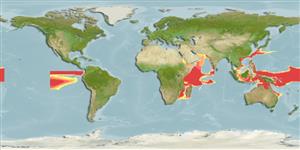
Indo-Pacific: southern part of the Arabian Sea, the Flores and Banda seas, and the equatorial Eastern Pacific.
印度-太平洋: 阿拉伯海的南部, 弗洛勒斯海與班達海, 與近赤道的東太平洋。
大小 / 重量 / 年龄
成熟度: Lm ? range ? - ? cm
Max length : 6.1 cm SL 雄鱼/尚未辨别雌雄; (Ref. 42080)
简单描述
检索表 | 型态特徵 | 形态测量图
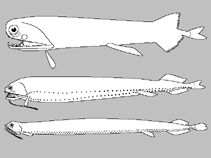
背的软条 (总数) : 15 - 16; 臀鳍软条: 13 - 14; 脊椎骨: 46 - 48. In fish measuring 6 cm SL or more, aggregation of luminous tissue on head appear as a band across gill cover; one or several luminous patches on flanks, close to the medial line of body in advance of pelvic fin insertion. Chin barbel shorter than head, its swollen tip forming wide flattened lobe with oblique ribs and with small medial notch. It differs from other species of the group in having more vertebrae (Ref. 27676).
Body shape (shape guide): elongated.
在测量 6个公分 SL 或更多的鱼中,在头部上的发光组织的群集呈现横过鳃盖的一条条纹; 在侧面上的一或一些发光的区块,接近身体的中间线在腹鳍嵌入前面。 下巴触须短于头部 , 它的肿大顶端形成宽的平叶有斜的肋骨而且有小的中间凹槽。 它与其他不同群的种有更多的脊椎骨.(参考文献 27676)
生命周期和交配行为
成熟度 | 繁殖 | 产卵场 | 卵 | 孕卵数 | 仔鱼
印度-太平洋: 阿拉伯海的南部, 弗洛勒斯海與班達海, 與近赤道的東太平洋。
Parin, N.V. and O.D. Borodulina, 1996. Revision of the Astronesthes indicus species group (Astronesthidae), with descriptions of five new species. J. Ichthyol. 36(8):551-565. (Ref. 27676)
世界自然保护联盟红皮书 (Ref. 130435: Version 2025-2 (Global))
人类利用
工具
特别资料
下载 XML
网络资源
基于模型的估算
首选温度 (参考文献
123201): 20.9 - 28.6, mean 26.5 °C (based on 73 cells).
系统发育多样性指数 (参考文献
82804): PD
50 = 0.5000 [Uniqueness, from 0.5 = low to 2.0 = high].
Bayesian length-weight: a=0.00407 (0.00167 - 0.00996), b=3.05 (2.83 - 3.27), in cm total length, based on LWR estimates for this (Sub)family-body shape (Ref.
93245).
营养阶层 (参考文献
69278): 3.5 ±0.6 se; based on size and trophs of closest relatives
回复力 (参考文献
120179): 高度, 族群倍增时间少于 15个月 (Preliminary K or Fecundity.).
渔业脆弱性 (Ref.
59153): Low vulnerability (10 of 100).
🛈